

Year 7 Mathematics in Australian Curriculum v9: What Students Learn
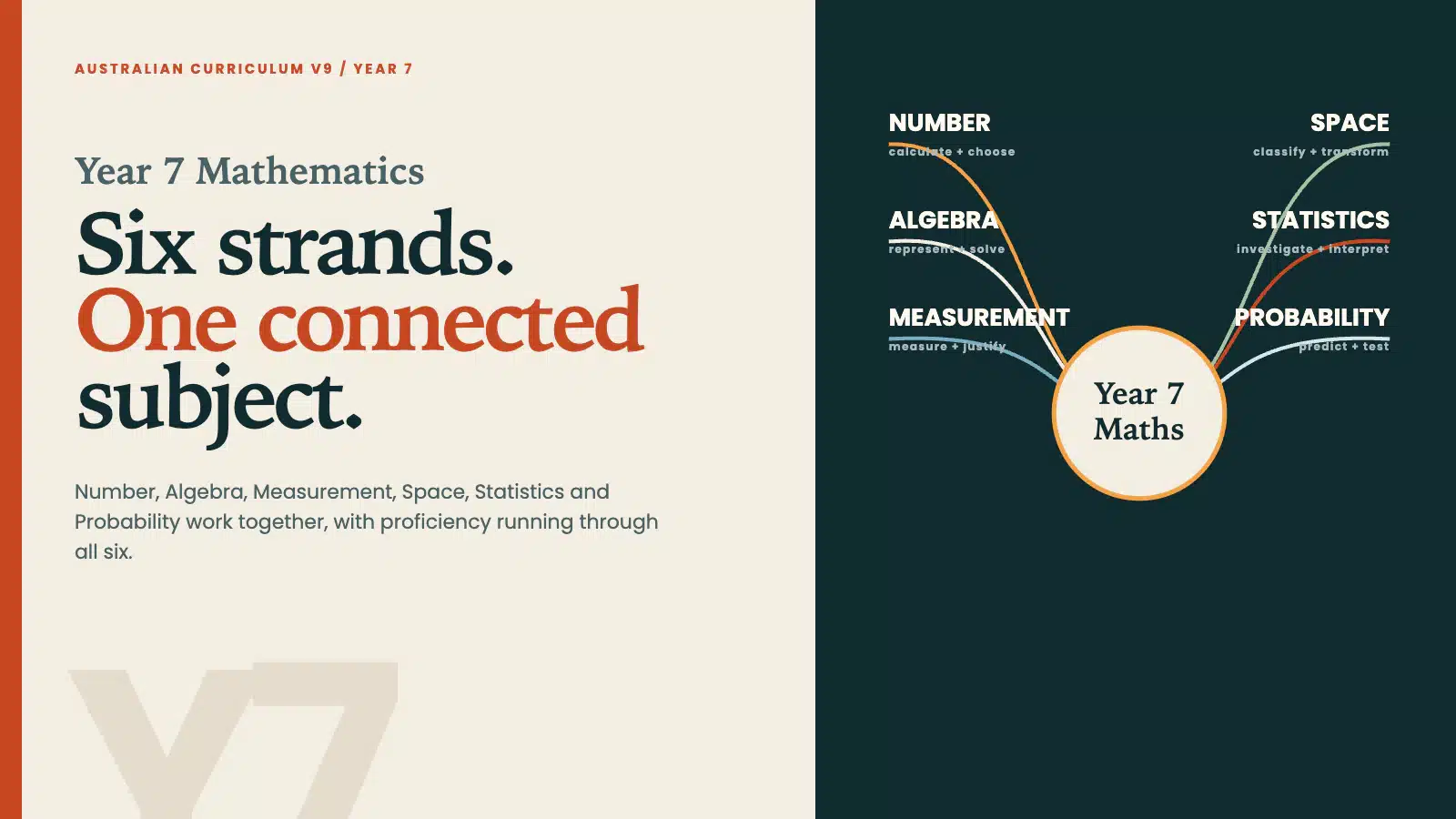
If your child is starting Year 7, here is the short answer. Year 7 Mathematics is a full year-level subject in Version 9 of the Australian Curriculum, with its own content and its own end-of-year achievement standard. The content is organised under six interrelated strands: Number, Algebra, Measurement, Space, Statistics and Probability. Running through all six is the expectation that students build understanding, fluency, reasoning and problem-solving as they work with the content. Those four are embedded in the curriculum itself rather than taught as extra subjects.
The national curriculum sets expectations for what students learn. Decisions about how that learning is organised and delivered sit with state and territory authorities, school sectors and schools. That is why two Year 7 classes can work towards related expectations through different local arrangements, textbooks and assessment programs.
| Nationally set | Locally decided |
|---|---|
| Year 7 content descriptions and the Year 7 achievement standard | Term sequence, textbooks and resources, tasks, calculator rules, homework and reporting details |
This guide sits alongside our broader Year 7 Australian Curriculum v9 parent guide, which covers all eight learning areas.
Six strands, one connected subject
The six official strand names are worth learning because they appear on the national curriculum pages and may also appear in school documents: Number, Algebra, Measurement, Space, Statistics and Probability.
ACARA describes the strands as interrelated, and the connections show up in the content itself. Number and Algebra connect through work with rational numbers, ratios, variables, formulas, equations, tables and graphs. Measurement and Space both involve reasoning about shape, position and quantities such as angle, area and volume. Statistics and Probability connect when students use repeated chance experiments or simulations, compare predictions with results, and reason about the data produced.
Earlier versions of the curriculum grouped this content into paired strands and described proficiency separately. Version 9 gives each of the six areas its own strand and embeds the expectation of mathematical proficiency into the content descriptions and achievement standards themselves. For parents, the practical effect is a clearer map: six named areas, one connected subject.

Mathematics the learning area also feeds Numeracy, a general capability that develops across every learning area. The two are related and distinct, and the difference is explained in our guide to the three dimensions of Australian Curriculum v9.
What Year 7 students learn across the six strands
The table below is a parent translation of the Year 7 content, drawn from the official curriculum and Queensland’s published alignment of the Year 7 achievement standard to the content descriptions. It is a map rather than the complete list of content descriptions.
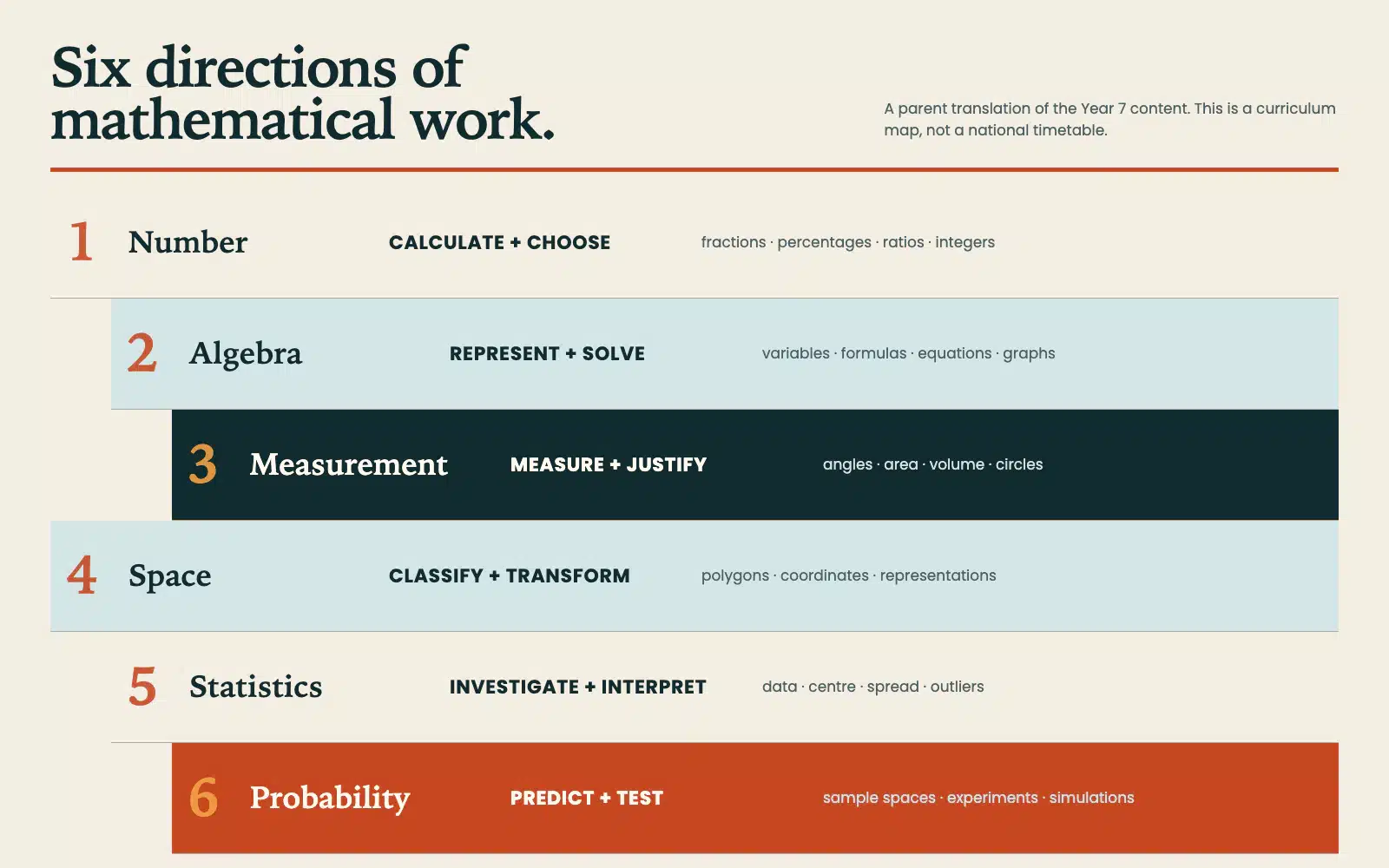
| Strand | Year 7 content includes | What it asks of your child |
|---|---|---|
| Number | Prime factors and exponent notation; squares and square roots of perfect squares; adding and subtracting integers; the four operations with positive fractions and decimals; equivalent forms of rational numbers and percentages; ratios; financial and other applied problems | Work flexibly across number forms, choose efficient strategies and explain why an answer makes sense |
| Algebra | Variables and formulas; algebraic expressions; one-variable linear equations with natural-number solutions; relationships shown in tables and graphs | Move between words, symbols, tables and graphs, and use them to solve and explain relationships |
| Measurement | Angle relationships; areas of triangles and parallelograms; volumes of rectangular and triangular prisms; how a circle’s radius, diameter and circumference relate; ratios in practical problems | Use formulas, units, angle facts and proportional thinking to solve measurement problems |
| Space | Classifying polygons; designing algorithms that sort shapes; representing objects in two dimensions; describing transformations with coordinates | Reason about shapes, representations and movement in the plane rather than only naming diagrams |
| Statistics | Discrete and continuous numerical data; data displays; range, median, mean and mode; shape, centre, spread and outliers; statistical investigations | Ask a statistical question, choose and display data, and justify what the data does and does not show |
| Probability | Sample spaces; assigning probabilities; predicted relative frequencies; repeated chance experiments and digital simulations | Describe possible outcomes, predict likelihood and compare predictions with repeated evidence |
In Number, students consolidate whole-number work through prime factors, powers and exponent notation, and meet squares and square roots of perfect squares. Integer work covers addition and subtraction; multiplying and dividing negative numbers comes in later years. The heart of the strand is rational numbers: fractions, decimals, percentages and ratios treated as different views of quantity and put to work in practical and financial problems.
Algebra introduces representing situations with variables and formulas. Students write and evaluate algebraic expressions, substitute values into formulas, and solve one-variable linear equations whose solutions are natural numbers. Tables and graphs sit beside the symbols, so a relationship between two quantities can be seen, described and checked in more than one form.
Measurement starts from angle relationships and the reasoning used to find unknown angles, then extends area to triangles and parallelograms and volume to rectangular and triangular prisms. Students also investigate how a circle’s radius, diameter and circumference relate, and use ratios where a practical problem calls for proportional comparison.
Space asks students to classify polygons by their features and to design algorithms, meaning step-by-step rules, that sort shapes. They represent objects in two dimensions and describe transformations of points using coordinates on the Cartesian plane.
Statistics moves from collecting discrete and continuous numerical data to summarising it with range, median, mean and mode, displaying it, and describing shape, centre, spread and outliers. The strand builds towards small statistical investigations in which students pose a question, gather and display data, and report what the data can and cannot support.
Probability works with single-stage chance events: listing the sample space, assigning probabilities and predicting how often an outcome should occur across many trials. Students then run repeated experiments and digital simulations and explain why observed results can differ from predictions.
Two cautions about this map. The curriculum does not allocate equal time to each strand, and it does not set which topics a school teaches first. Both decisions belong to your child’s school and its jurisdiction.
What “working mathematically” looks like in Version 9

Four words recur across the Year 7 content and achievement standard: understanding, fluency, reasoning and problem-solving. In plain English, understanding means knowing why a method works and how ideas connect. Fluency means choosing appropriate procedures and carrying them out accurately and efficiently. Reasoning means explaining, justifying, comparing and generalising. Problem-solving means planning an approach when the path is unclear, trying strategies, and interpreting the result against the original situation.
These are embedded expectations woven into the content, not four extra strands or four separate marks on every task. When a school report comments on your child’s reasoning, it may be describing a quality of the same maths work rather than an additional subject.
Version 9 also names processes through which proficiency becomes visible: mathematical modelling, computational thinking, statistical investigation, and probability experiments and simulations. In a Year 7 classroom that can look like modelling a budget with percentages, writing a step-by-step rule for sorting shapes, running a small data investigation, or simulating a chance experiment and comparing prediction with outcome.
Reading one real curriculum entry
Official curriculum pages are dense, so here is one Year 7 entry read the way a parent might use it. In the Number strand, content description AC9M7N09 asks students to use mathematical modelling to solve practical problems involving rational numbers and percentages, including in financial contexts. Students formulate the problem, choose representations and efficient calculation strategies, use digital tools where appropriate, interpret and communicate the solution in terms of the situation, and justify the choices they made.

The parent translation: the goal is bigger than calculating a percentage. A student works out what the situation is asking, picks a useful representation or strategy, does the calculation, and explains why the answer fits the situation.
An illustrative task, and only illustrative: a school might build a lesson around comparing discounts, planning a small budget or weighing up phone plans. ACARA does not prescribe any such task; the teacher chooses it locally.
Looked at through this lens, five things in your child’s work are worth noticing: how they framed the situation, the strategy they chose, the calculation itself, how they interpreted the result, and whether they can justify their choices.
Alongside content descriptions you may also see elaborations. These are optional suggestions and illustrations for teachers, and no student is required to complete them all. Our guide to content descriptions, elaborations and achievement standards walks through each of these terms.
How to read the Year 7 achievement standard
The Year 7 achievement standard describes the expected quality of learning that students typically demonstrate by the end of Year 7. It is written as connected prose spanning all six strands, which makes it precise and also hard to skim.
Grouped for parents, the standard says that by the end of Year 7 a student can typically demonstrate six connected outcomes:
- Numbers and proportional reasoning: choosing and using number representations and operations, including integers, rational numbers, percentages and ratios.
- Algebraic representation: expressing situations with variables, formulas, equations, tables and graphs.
- Measurement reasoning: applying angle relationships, area and volume formulas, and circle relationships.
- Spatial reasoning: classifying and representing shapes and describing coordinate transformations.
- Statistical investigation: planning investigations, displaying numerical data and reasoning about centre, spread and outliers.
- Probability and simulation: constructing sample spaces, assigning probabilities, predicting relative frequencies and comparing predictions with results.
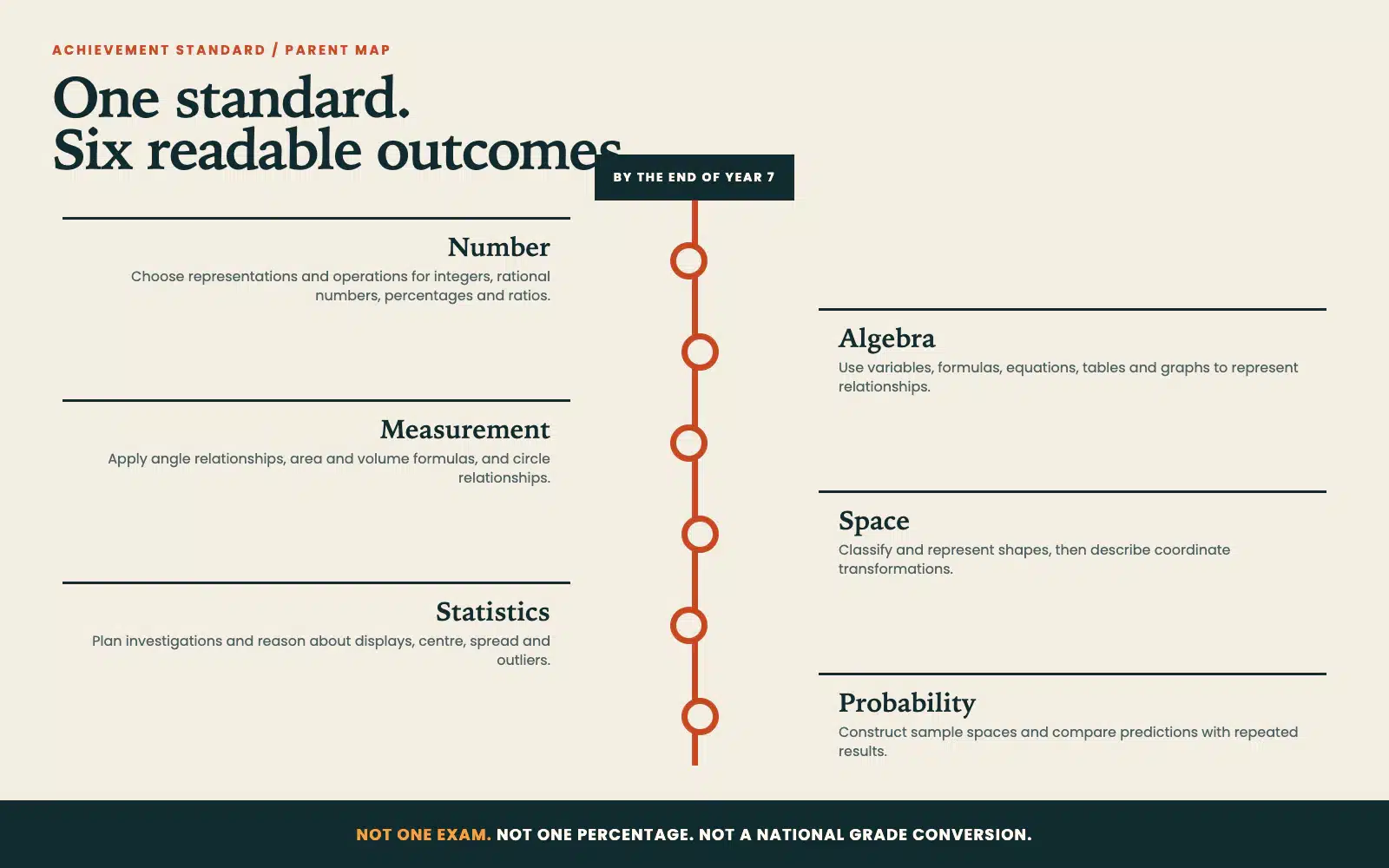
The achievement standard is an end-of-Year-7 description of expected learning. It is not one exam, one percentage or a national A–E conversion table.
The full wording is on ACARA’s Year 7 Mathematics page. It is one national reference point for understanding expected learning. The curriculum or syllabus used locally, together with jurisdiction, sector and school reporting arrangements, guides how that learning is taught, assessed and reported.
The Years 7–8 parent summary is useful, and broader
ACARA also publishes a plain-language summary for families called What students learn during the first 11 years of school. Its secondary mathematics section describes Years 7 and 8 together. The summary is worth reading, with one caution: it is broader than the Year 7 curriculum page, and not every item in the summary is a Year 7 requirement.
Pythagoras’ theorem is the clearest example. It appears in ACARA’s Years 7–8 parent summary, alongside irrational numbers. Neither appears in the Year 7 achievement standard or the Year 7 content on the official curriculum page. The banded parent summary alone therefore cannot tell you that either topic belongs in Year 7.
A school’s own program can place topics differently within its jurisdiction’s rules, so one Year 7 class may meet a topic earlier or later than a class down the road. When an official parent summary and your child’s classwork seem to disagree, first check whether one document describes Years 7–8 broadly while the other describes Year 7 or a local school program.
Why your child’s school may teach topics in a different sequence
Between the national curriculum and your child’s Tuesday maths lesson sit several layers of decision-making.

The flow runs from ACARA’s national curriculum, to the state or territory authority and school sector, to the school’s program, to the classroom sequence and its assessment. Each layer settles questions the layer above leaves open.
Queensland shows a direct route. The Queensland Curriculum and Assessment Authority publishes resources aligned to Australian Curriculum v9.0, including a Year 7 Mathematics document that maps the achievement standard line by line to content descriptions. Queensland classrooms work from the national content through QCAA materials.
NSW shows a translated route. NSW teaches Years 7 to 10 mathematics through its own Mathematics K–10 Syllabus (2022), which places Year 7 in Stage 4 and uses a Core–Paths structure, with schools deciding which path focus areas students engage with. This is a NSW presentation of the same learning area, and it is why NSW school communication can use names and codes that differ from the national pages.
Other jurisdictions make their own arrangements again. What the national framework does not set is a single term order, textbook, homework policy, calculator rule, assessment calendar or grading method; those are local decisions. Our state and territory guide covers how each jurisdiction handles the curriculum.
If your child is finding Year 7 maths hard
Year 7 classrooms can hold a wide spread of prior knowledge. The most useful first move is to make the problem smaller and more specific.

- Ask which exact content or process is hard right now. “Maths” is too big to act on; “solving equations when the unknown is on the right” is workable.
- Look at worked evidence rather than the overall mark. A test score compresses a term of thinking into one number; the working shows where the thinking breaks.
- Separate the places working can break down: understanding the question, choosing a method, carrying out the steps, checking the answer and explaining the reasoning. These can break independently, and each calls for different practice.
- Ask what the class is learning now and what prior skill it assumes. If current fractions work is difficult, the relevant foundation is worth checking first.
- Agree one specific next practice step and a time to review it. One step with a review date beats a general resolution to try harder.
The national Mathematics Hub gives families advice in the same spirit: ask your child to show you how they solved a problem, use everyday contexts such as discounts and cooking, and celebrate logical explanation and understanding rather than speed.
One weak result, one hard unit or a term of grumbling about maths is evidence worth investigating, and nothing more than that. It tells you where to look; it does not tell you what you will find.
Four questions to ask the teacher
Taken into a parent-teacher conversation, these four questions turn worry into a plan:
- “Which Year 7 content or skill is the class working on now?”
- “Can you show me where my child is getting stuck: understanding the question, choosing a method, doing the calculation or explaining the reasoning?”
- “What does secure work look like for this unit in your program?”
- “What is one specific thing we can practise, and when should we check again?”
The third question earns its place because “secure work” is judged within the school’s own program. The person who can show you the local expectation is the teacher.
Frequently asked questions
What topics are in Year 7 maths in Australia?
Year 7 Mathematics spans six strands: Number, Algebra, Measurement, Space, Statistics and Probability. Core topics include integers, fractions, decimals, percentages and ratios; variables, formulas and linear equations; angle relationships, area and volume; polygon classification and coordinate transformations; data displays and summary statistics; and sample spaces and chance experiments. The order in which a school covers them is a local decision.
What are the six strands of Australian Curriculum Mathematics?
Number, Algebra, Measurement, Space, Statistics and Probability. Version 9 introduced this structure, replacing the earlier paired strands and making each discipline visible while keeping the connections between them.
Is Year 7 Mathematics the same in every Australian state?
The national curriculum provides a shared framework, and its implementation differs. NSW, for example, teaches the learning area through its own Mathematics K–10 Syllabus with Year 7 in Stage 4, while Queensland works directly from Australian Curriculum v9.0 through QCAA materials. Names, codes and sequence can vary locally.
Is Numeracy the same as Mathematics?
They are related and distinct. Mathematics is the learning area with its own curriculum each year. Numeracy is a general capability developed across all learning areas, with Mathematics playing the leading role in building it.
Are understanding, fluency, reasoning and problem-solving separate strands?
No. In Version 9 they describe mathematical proficiency, and the expectation of proficiency is embedded in the content descriptions and achievement standards across all six strands. They are qualities of the work rather than extra subjects or separate marks.
Does Year 7 include Pythagoras’ theorem?
It is listed in ACARA’s parent summary for Years 7–8, and it does not appear in the Year 7 achievement standard or Year 7 content descriptions. A local program may introduce it at a different point across Years 7–8, so ask your school where it falls in its sequence.
Does the achievement standard equal a C grade?
There is no national rule converting the achievement standard into a grade. In Queensland, the schooling sectors have collectively decided that the achievement standard is the C standard reference on a five-point scale, commonly A to E. That is a Queensland decision, and other jurisdictions report in their own ways, so ask your school how it reports.
Are calculators required or banned in Year 7?
There is no single national calculator rule. Some content descriptions call for digital tools where appropriate; schools and jurisdictions set the calculator rules that apply to particular classes and tasks.
How can I tell what my child’s school is teaching this term?
Ask the teacher or check the school’s published program. The national curriculum pages list what Year 7 covers across the whole year, and they cannot tell you the order your child’s school has chosen for its terms.
What should I do if my child is struggling?
Narrow the problem to a specific skill or process, ask the teacher for worked evidence and the current local expectation, and agree one practice step with a review date. ACARA’s own advice to families is to contact the teacher and arrange to discuss any concerns directly.
The short version
You do not need to memorise curriculum codes to support a Year 7 student. Know the six-strand map, know that understanding, fluency, reasoning and problem-solving run through all of it, and treat the achievement standard as a year-end description rather than a test score. When something looks wrong, ask what the class is doing now and where exactly the working breaks down.
For the wider picture across every learning area, KeirEd’s complete parent guide to Australian Curriculum v9 is the place to start. And if you would like help turning teacher feedback and current classwork into a focused support plan, you can explore KeirEd’s maths tutoring in Brisbane whenever you are ready.
Official sources
- ACARA: Understand this learning area, Mathematics
- ACARA: Mathematics, Year 7 curriculum page
- ACARA: About the curriculum content elements
- ACARA: Parent and carer information
- ACARA: What students learn during the first 11 years of school
- ACARA: Revisions to the Australian Curriculum, Mathematics
- QCAA: Year 7 Mathematics, achievement standard aligned to content descriptions (PDF)
- QCAA: P–10 Mathematics overview, Version 9.0
- NSW Department of Education: Mathematics K–10 Syllabus (2022) information for school leaders
- Mathematics Hub: Year 7 Mathematics at school, what to expect
Last reviewed: 8 August 2026