

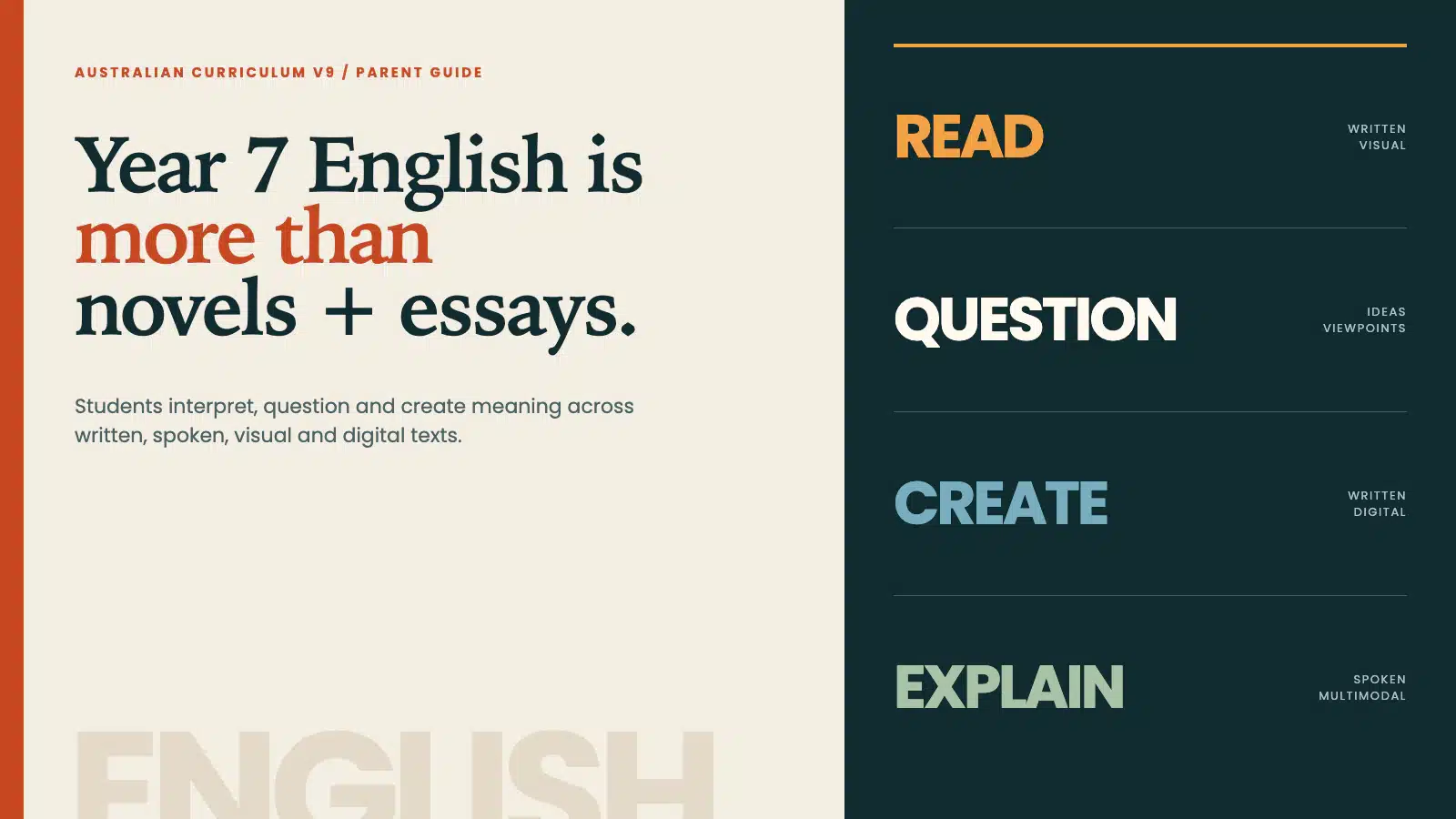
Year 7 English in Australian Curriculum v9: What Students Learn
Year 7 English is not just novels and essays. Under Version 9 of the Australian Curriculum, students learn to listen, speak, read, view, write and create; analyse how texts shape meaning; support their ideas with evidence; and communicate for different purposes and audiences. The subject is organised into three interrelated strands — Language, Literature and Literacy — which work together inside English rather than running as separate subjects.
The national curriculum sets those Year 7 expectations. Your child’s school decides how to bring them to life: which texts the class studies, how units are ordered, what the assessment program looks like and how progress is reported, all within the arrangements of its state, territory or sector. This guide translates the official Year 7 English expectations into plain language. If you want the whole-year picture across every subject, start with our Year 7 Australian Curriculum guide.
The 60-second answer
Here is what Year 7 English asks students to do, in one table.
| Students learn to… | Parent translation |
|---|---|
| Read, view and interpret | Understand and question novels, poems, films, media, information and digital texts |
| Discuss and justify | Explain a view, listen to others and use evidence from a text or source |
| Write and create | Build organised imaginative, informative, persuasive, reflective and analytical texts |
| Use language deliberately | Choose structure, sentences, vocabulary, punctuation, literary, visual and voice features to suit audience and purpose |
Spelling, grammar, punctuation, editing, oral communication and multimodal work all remain part of English in Year 7 — none of them stops at the end of primary school.
There is one national Year 7 achievement standard, but there is no single national book list, unit order, assessment calendar or grading formula. Those details come from your child’s school and its state, territory or sector, which is why two Year 7 students in different schools can be studying different texts while working toward the same national expectations.
How Year 7 English is organised
The Australian Curriculum presents English year by year from Foundation to Year 10, and organises the content at every level under three interrelated strands.
Language is knowledge of how English itself works: how interaction, text structure, grammar, punctuation, vocabulary and visual elements make meaning, and how language shifts with context, audience and purpose.
Literature covers literary texts: understanding the contexts they come from, interpreting and analysing them, weighing their value, and creating literary texts of the student’s own.
Literacy is the ability to put that knowledge to work — interpreting and creating increasingly complex spoken, written, visual, digital and multimodal texts across school and life.
Two clarifications save a lot of confusion. First, these are strands inside the one subject called English — not three separate subjects your child is enrolled in. Second, the language modes — listening, speaking, reading, viewing and writing — are developed in integrated ways. A single classroom activity might involve reading a text, discussing it aloud and writing a response, and the curriculum treats those as connected rather than as isolated blocks.
One naming change is worth knowing: from Year 7, the sub-strand previously called "Phonic and word knowledge" becomes "Word knowledge". Spelling does not disappear — Year 7 students still work explicitly on spelling rules, word origins, roots, prefixes, suffixes and spelling patterns.
If you have seen the phrase "three dimensions" of the Australian Curriculum, that refers to something different: the whole curriculum’s learning areas, general capabilities and cross-curriculum priorities. The three English strands sit inside one learning area. Our guide to the three dimensions of Australian Curriculum v9 explains that wider structure.

What students actually do in Year 7 English
The curriculum describes Year 7 English through content descriptions across the three strands. Rather than reproduce the full list, here is what the expectations look like grouped the way a parent sees the work.
Read, view and interpret
Year 7 students work with texts that may inform, influence and/or engage audiences — from novels, poetry and short stories to news media, documentaries, advertisements and digital texts. They learn to identify how ideas and viewpoints are portrayed, and how context, structure, language choices, literary devices and visual features shape what a text means. They also practise comprehension strategies — questioning, inferring, monitoring their own understanding and summarising — so they can handle texts that are longer and denser than in primary school.
Respond to literature
The Literature strand asks students to engage with perspectives, characters, settings and events, and to consider where a text comes from and whose viewpoint it carries. The curriculum includes First Nations Australian voices, wide-ranging Australian literature and world literature, including texts from and about Asia. Students explore literary devices and layers of meaning, including in poetry, and learn to form their own opinion of a text, support it with evidence from the text, and compare it respectfully with other people’s responses.
Write and create
Year 7 students plan, draft, edit and publish texts for imaginative, reflective, informative, persuasive and analytical purposes, in written and multimodal forms. The emphasis is on organising, developing and linking ideas so a piece holds together for its intended audience — and on treating editing as part of writing, not an optional extra.
Grammar, vocabulary, punctuation and spelling
Language conventions remain explicit in Year 7. Representative content includes cohesion — the signals that connect ideas across a paragraph or text; complex and compound-complex sentences; keeping tense consistent; building specialist and technical vocabulary; using punctuation such as colons and brackets; and word knowledge covering origins, roots, base words, prefixes, suffixes and spelling patterns. These are representative examples rather than an exhaustive or equally weighted list — schools decide how much time each element gets and when.
Speak, listen and present
Oral and multimodal communication carries real weight in Year 7. Students discuss and evaluate ideas, listen and respond to others, and support what they say with evidence. They present for a purpose and an audience, learning to use voice features such as volume, tone, pitch and pace, and they create spoken and multimodal texts — not just written ones.

Illustrative, not a national task. To make this concrete: a Year 7 class might compare how a novel and its film adaptation represent a character, then create a review or a short multimodal presentation about it. That is the kind of task the curriculum supports — but no specific task, text or timing like this is nationally required. Your child’s actual units come from their school.
What the Year 7 achievement standard means
Alongside the content, the curriculum sets a Year 7 achievement standard. An achievement standard describes the expected quality of learning students should typically demonstrate by the end of the year — a description of capability, not a score.
In plain English, the Year 7 English standard covers three broad end-of-year performances:
- Interact, listen and speak — students engage in discussion, listen and respond to others, and create spoken and multimodal texts that share ideas for a purpose and audience.
- Read, view and comprehend — students make sense of texts of growing complexity and explain how context, structure, language, literary and visual features shape meaning.
- Write and create — students produce organised written and multimodal texts that develop ideas and make deliberate language choices for their audience and purpose.
The achievement standard is not a national A–E grading formula, a single test or a checklist completed in one assignment. States, territories, sectors and schools set their own assessment and reporting arrangements, so how the standard translates into your child’s report depends on where they go to school.
If you want the full official wording, it is published on ACARA’s Year 7 English page, and our guide to content descriptions, elaborations and achievement standards explains how these curriculum terms fit together. One term worth knowing here: the curriculum’s content descriptions set the essential knowledge and skills, while the "elaborations" that sit beneath them are optional suggestions and illustrations for teachers — not compulsory lessons.

Which books and "topics" will Year 7 study?
The direct answer first: there is no single national Year 7 English book list. Any article that presents one is describing a particular school’s program, not the Australian Curriculum.
What the national curriculum does set is a range. Across the year, texts can be literary and non-literary; written, spoken, visual, multimodal, print and digital. The curriculum includes First Nations Australian literature, wide-ranging Australian authors and world literature, including texts from and about Asia, drawn from diverse historical, social and cultural contexts. In practice the forms may include novels, short stories, poetry, drama, film, speeches, media and digital texts — those examples are illustrative, and no term-by-term mix is mandated nationally.
Who chooses the actual titles? ACARA’s position is that teachers and schools are best placed to select texts for their programs. So the answer to "which books?" comes in three layers:
- the national curriculum sets the content expectations and the breadth of text types;
- a state, territory or sector may add its own syllabus requirements — NSW, for example, runs its own English syllabus with Stage 4 structures and local text requirements for Years 7–10, so a NSW school can show parents a more specific local document (that is a NSW arrangement, not a national template);
- the school then selects the books, builds the units and sets the task sequence.
If you want to know what your child will actually read this year, the school’s subject outline or the teacher is the right source — and it is a completely reasonable thing to ask for.
Why Year 7 English can look different by state and school
Because responsibility is shared, the same national expectations reach your child through several layers of local decisions:
ACARA Year 7 English expectations → jurisdiction or sector curriculum or syllabus → school program and text choices → classroom tasks and reporting
States, territories, sectors and schools make the decisions about curriculum organisation and delivery, teaching programs and reporting arrangements. Concretely: NSW parents will mostly see NESA’s English K–10 Syllabus and Stage 4 language rather than ACARA’s year-level pages, while Queensland parents may see QCAA materials that align the Australian Curriculum for local use. Other jurisdictions use direct, adapted or locally named versions of the framework — our Australian Curriculum by state and territory guide maps who uses what.
The practical takeaway: if your child’s class is reading a different novel from a cousin’s class interstate, or assessing with different tasks at different times, that alone does not mean either school is off-curriculum. It usually means each school is making the local choices the system expects it to make.

If your child is finding Year 7 English difficult
Year 7 English asks students to coordinate a lot at once, and a difficulty is rarely "bad at English" across the board. It usually sits somewhere specific:
- reading accuracy or fluency;
- vocabulary or background knowledge;
- comprehension and inference;
- planning and organising ideas;
- sentence construction, spelling or editing;
- interpreting task instructions or applying feedback;
- oral expression, confidence or managing the workload.
One weak assignment or test result does not identify which of these is the barrier — it only signals that something is worth a closer look. The most useful first step is a conversation with the teacher: ask what evidence they are seeing across different tasks, and which part of the reading or writing process seems to be creating the difficulty.
Australian education research on secondary students makes the same point from the other direction: where students need targeted support with foundational reading or writing, effective support starts by identifying the specific need and then monitoring progress, rather than applying a generic fix.
It is also worth knowing that the curriculum itself anticipates diverse learners. ACARA provides for multiple ways of representing, engaging with and expressing learning, and notes that assessment modes may be varied — a student might, for example, be assessed through an alternative to a whole-class oral presentation. What any individual school offers is worked out with the school, so the right move is to discuss options rather than assume a particular arrangement.

Three useful questions for the teacher
These work in a parent-teacher interview, an email or a quick conversation:
- "Which curriculum or syllabus document is this Year 7 English program using?"
- "Which reading, writing, speaking or viewing skill is the main focus right now, and what evidence shows how my child is going?"
- "What text or task is coming next, and what would useful practice at home look like without doing the work for them?"
If you have a specific concern, a fourth question narrows things down quickly: "Is the difficulty mainly understanding the text, organising ideas, sentence-level writing, spelling/editing or interpreting the task?"
Frequently asked questions
What do students learn in Year 7 English?
Students learn to listen, speak, read, view, write and create across a wide range of texts. They analyse how language, structure, context and literary and visual features shape meaning; support their ideas and opinions with evidence; and create organised written, spoken and multimodal texts for different purposes and audiences. Grammar, vocabulary, punctuation, spelling and editing remain explicit parts of the subject.
What are the three strands of Year 7 English?
Language, Literature and Literacy. Language is knowledge of how English works; Literature covers responding to, analysing, valuing and creating literary texts; Literacy applies that knowledge to interpreting and creating spoken, written, visual, digital and multimodal texts. They are interrelated strands inside the one subject, not three separate subjects — and most classroom work draws on all three at once.
Does Year 7 English include grammar and spelling?
Yes. Year 7 students work on cohesion, complex and compound-complex sentences, tense consistency, specialist vocabulary and punctuation such as colons and brackets. From Year 7 the relevant sub-strand is called Word knowledge, and it covers spelling rules, word origins, roots, base words, prefixes, suffixes and spelling patterns. The name changes from primary school; the spelling instruction does not stop.
Which books do Year 7 students read in Australia?
There is no national Year 7 book list. The curriculum sets a range — literary and non-literary; written, spoken, visual, multimodal, print and digital; First Nations Australian, Australian and world literature, including texts from and about Asia — and teachers and schools are best placed to select the actual texts. Ask the school for its subject outline to see this year’s titles.
Is Year 7 English the same in every state?
The national curriculum sets common Year 7 expectations, but states, territories, sectors and schools decide how it is organised, taught, assessed and reported. NSW, for example, delivers English through NESA’s own syllabus with Stage 4 structures. Different texts, tasks or timing between schools do not by themselves mean any school is off-curriculum.
What is a multimodal text?
A multimodal text combines two or more communication modes — such as print, image and spoken text. A picture book combining words and images, or a presentation combining slides and speech, are everyday examples. Year 7 students both interpret multimodal texts and create their own, which is why some English tasks look quite different from a traditional essay.
Is the achievement standard the same as a C grade?
No. Nationally, the achievement standard describes the expected quality of learning by the end of Year 7 — it is not an A–E formula, a score or a single test. Grading rules are set locally. In Queensland, for instance, sectors use the achievement standard as the basis of the C standard or equivalent, but that is a Queensland assessment arrangement, not a national definition.
Is Year 7 NAPLAN the same as the English curriculum?
No. Year 7 students sit NAPLAN, but it assesses literacy and numeracy — skills that cross subjects — rather than the whole English curriculum. A NAPLAN result is not an English grade. Treat it as one snapshot among the wider evidence the school gathers across reading, writing, speaking, viewing and creating.
How can I tell which English skill my child needs help with?
Ask the teacher what evidence they are seeing across different tasks, and which part of the process — reading the text, understanding ideas, organising a response, sentence-level writing, spelling and editing, or speaking — is creating the barrier. One weak result cannot pinpoint the cause on its own, so look for a pattern across tasks before drawing conclusions.
How can parents help with Year 7 English at home?
Stay close to what the class is actually doing: ask the teacher what text or task is coming next and what useful practice at home looks like without doing the work for your child. Talking about books, films and media — what a text is trying to do and how — supports the same analytical habits Year 7 English builds. Keep it low-pressure and specific.
Where to go next
For the broader picture around Year 7 English, three guides carry on from here: the terms guide and state guide linked above, and our full Australian Curriculum v9 parent guide, which connects every year level and learning area in one place.
For support with a particular reading, writing or assessment difficulty, explore KeirEd’s English tutoring programs. We discuss the skill your child needs to work on and whether the program’s live teaching, practice and individual help fit their needs.
Official sources
- ACARA — Understand this learning area: English
- ACARA — English Year 7 annotated work sample and achievement standard
- ACARA — About the curriculum content elements
- ACARA — Parent/carer information, including the Years 7–8 parent summary
- QCAA — Year 7 English achievement standard aligned to content descriptions — Queensland alignment
- NESA — English K–10 Syllabus course overview — NSW syllabus
Last reviewed: 4 August 2026.