

Does Every Australian State and Territory Use Australian Curriculum v9?
Last reviewed 21 July 2026. Curriculum rollout details change — the live authority links in this guide always take precedence over any date printed on this page.
Yes — but not in one identical form or on one identical schedule.
If the national Australian Curriculum website, your state’s syllabus pages and your school’s materials do not quite match, nothing is wrong. They are three layers of the same system, doing different jobs.
The 60-second answer
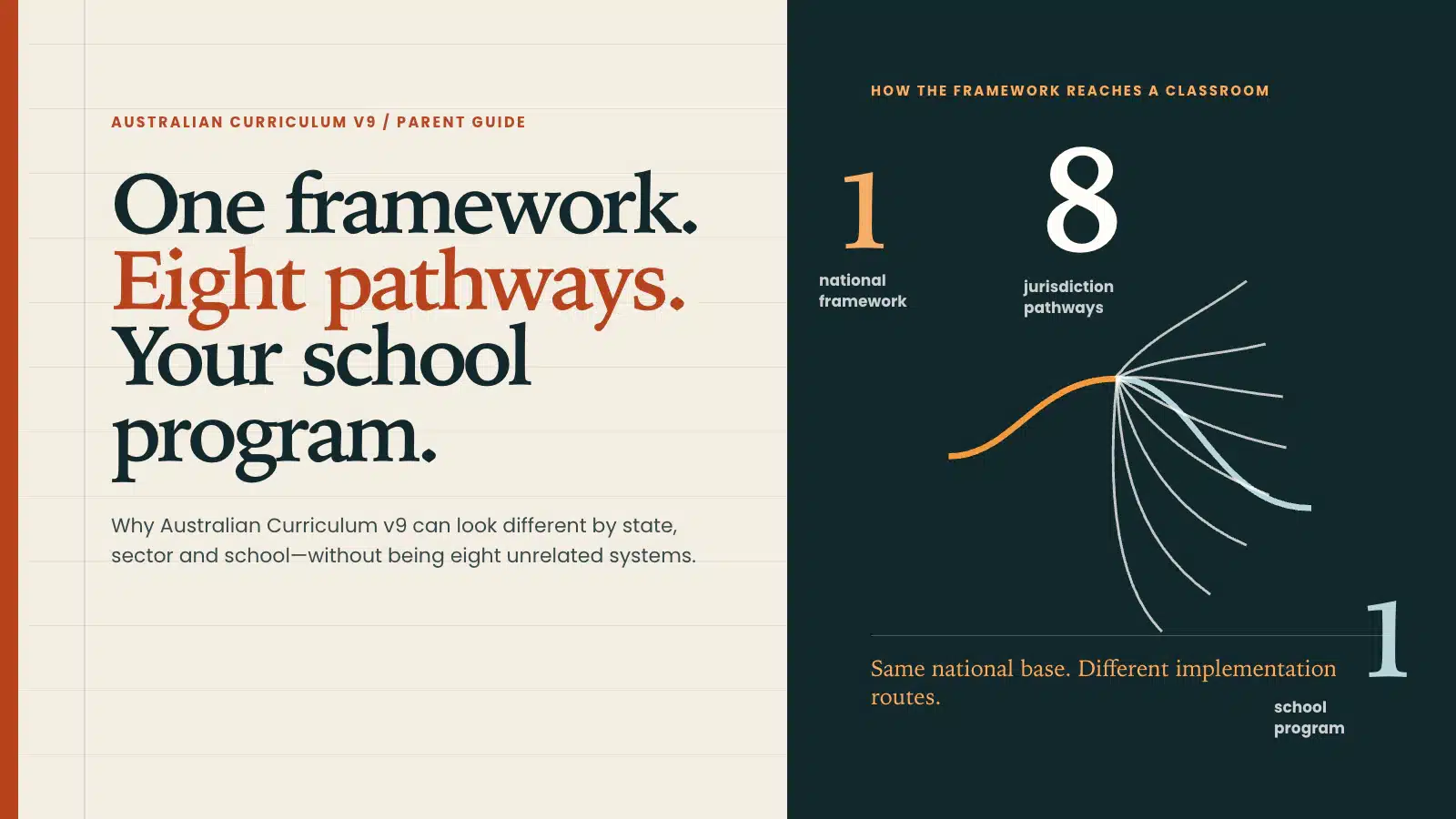
Every Australian state and territory works from the Australian Curriculum as the agreed national framework for Foundation to Year 10. What differs is how — and when — that framework becomes the curriculum your child actually experiences. Some schools work directly from Australian Curriculum Version 9; others follow a state or territory curriculum or syllabus that incorporates or adapts it.
| Layer | What it answers | Where to look |
|---|---|---|
| 1. National framework | What Australian students are broadly expected to learn across Foundation–Year 10 | ACARA’s Australian Curriculum website |
| 2. Your state or territory (and school sector) | Which curriculum or syllabus applies locally, and when | Your state or territory curriculum authority — and, where relevant, your school’s sector |
| 3. Your child’s school | The program, sequence, resources and timing your child actually experiences | The school itself |
Use all three together. No single layer answers every question on its own.
One scope note before we go further: this guide covers Foundation (called Prep or Kindergarten in some jurisdictions) to Year 10. Years 11 and 12 work differently, and we come back to that boundary near the end.
One framework, many pathways: why a national curriculum can look different by state
In April 2022, Australia’s education ministers approved Version 9.0 of the Australian Curriculum — the current national framework for Foundation to Year 10. If you’d like a plain-language tour of the framework itself, start with our Australian Curriculum v9 parent guide; if you’re wondering how Version 9 differs from the previous version, we’ve covered what changed in Australian Curriculum v9 separately.
Approving a national framework and teaching it in classrooms are not the same event. Publication, familiarisation, planning and classroom implementation do not happen everywhere at once. As ACARA’s implementation overview explains, states, territories, non-government school sectors and schools determine the timing and approach.
In words, the flow looks like this:
ACARA’s national framework → your state or territory authority (and, where relevant, your school sector) → your school’s program → your child’s classroom.
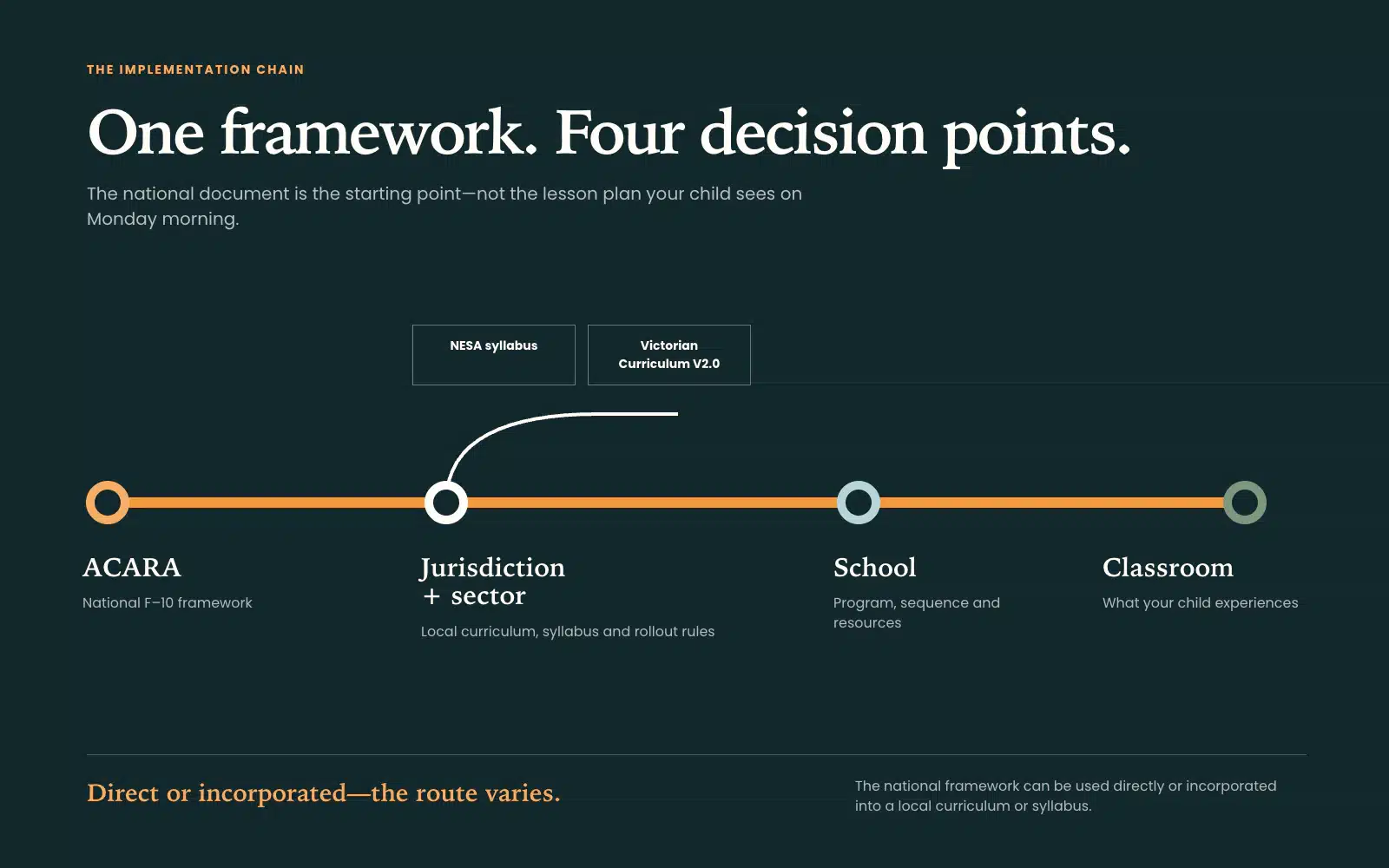
At the second step, the paths genuinely diverge. Some schools work directly from the Australian Curriculum as ACARA publishes it. Others follow a curriculum or syllabus published by their own state or territory authority — one that incorporates or adapts the national framework, sometimes under a different name, with different codes and its own rollout timeline. A different label on the cover does not mean the national framework has been set aside; in most cases it means the national content has been translated into a local document.

The national framework is not a single ready-made school program. ACARA says schools develop teaching and learning programs under jurisdiction and sector policies, responding to their students and local contexts. Two nearby schools can therefore both be implementing Version 9 while their sequence and classroom materials differ.
The eight jurisdictions at a glance
Last reviewed 21 July 2026. Rollout arrangements are a moving picture. Treat this table as a dated snapshot and use the links for the current position.
On a smaller screen, swipe the table sideways to compare all four columns.
| State / territory | What parents will see | Best official source | Current caution |
|---|---|---|---|
| ACT | Public schools must meaningfully incorporate the Australian Curriculum’s learning areas, general capabilities and cross-curriculum priorities; the Education Directorate determines which version is implemented | ACT Education Directorate — Learning and Teaching Policy | The policy covers public schools; Catholic and independent schools have separate arrangements |
| New South Wales | NESA syllabuses that incorporate Australian Curriculum content through an “adopt and adapt” approach; new K–10 syllabuses align with Version 9 | NSW Curriculum (NESA) and the NSW syllabus timeline | Implementation dates differ by syllabus and may change |
| Northern Territory | NT schools deliver the Australian Curriculum; Version 9 phased in — English, Mathematics and Health & PE by 2025, with Technologies, HASS, Languages and the Arts by 2026 | NT school curriculum | The live page still carried this schedule on 21 July 2026; recheck before publication |
| Queensland | Schools plan, teach, assess and report using the Australian Curriculum in Prep–Year 10, supported by QCAA’s Version 9 resources | QCAA — Australian Curriculum in Queensland (v9) | Check the relevant learning-area page and the school for the current implementation position |
| South Australia | Public schools progressively adopting the South Australian Curriculum for Public Education, adapted from Version 9 | SA Department for Education | Applies to public education specifically; timing details are time-sensitive |
| Tasmania | In government schools, Australian Curriculum Version 9.0 is the core Prep–Year 10 framework under a current DECYP procedure | DECYP Learning Plan Procedure (PDF) | Government schools only; other sectors set their own arrangements |
| Victoria | Victorian Curriculum F–10 Version 2.0, which incorporates much of Australian Curriculum v9 but differs in structure and Victorian priorities | VCAA — Victorian Curriculum F–10 V2.0 and the implementation timeline | Timelines vary by curriculum area and by sector (as of Term 2 2026) |
| Western Australia | The Western Australian Curriculum and Assessment Outline, which adopts and adapts Version 9; revised HASS, Mathematics, Science and Technologies mandatory in 2026 | WA K–10 Outline (SCSA) and the February 2026 circular | The 2026 mandate covers those four learning areas; others may sit on different schedules |
A caution that applies to every row: government, Catholic and independent arrangements can differ within a single jurisdiction. Where a linked source describes government schools only, we’ve said so — don’t assume it covers your child’s school if your child is in another sector.
The two systems that confuse parents most
NSW and Victoria generate most of the “so do they use it or not?” questions, because both publish a curriculum under their own name. Neither is outside the national framework. Here’s what’s actually happening.
New South Wales: Australian Curriculum content inside NESA syllabuses
In NSW, the NSW Education Standards Authority (NESA) has legislative responsibility under the NSW Education Act 1990 for setting and monitoring the K–12 curriculum. NESA incorporates Australian Curriculum content into NSW K–10 syllabuses through an “adopt and adapt” approach, and its new syllabuses are aligned with Version 9.

So a NSW parent will mostly use NESA syllabuses rather than the national website. The NSW Curriculum structure is organised by stages, and its syllabuses include outcomes and content rather than mirroring ACARA’s layout.
Timing is the other trap. NSW is not switching every subject over at once: syllabus consultation, release, planning and implementation dates differ by syllabus, and NESA explicitly notes they may change. Rather than reprinting a schedule that could be out of date within a term, check the current NSW syllabus timeline for the subjects and years that affect your child (last reviewed 21 July 2026).
Bottom line for NSW parents: the Australian Curriculum reaches your child through NESA syllabuses. Follow the syllabus your school names, not the national site alone.
Victoria: a Victorian curriculum that incorporates much of Version 9
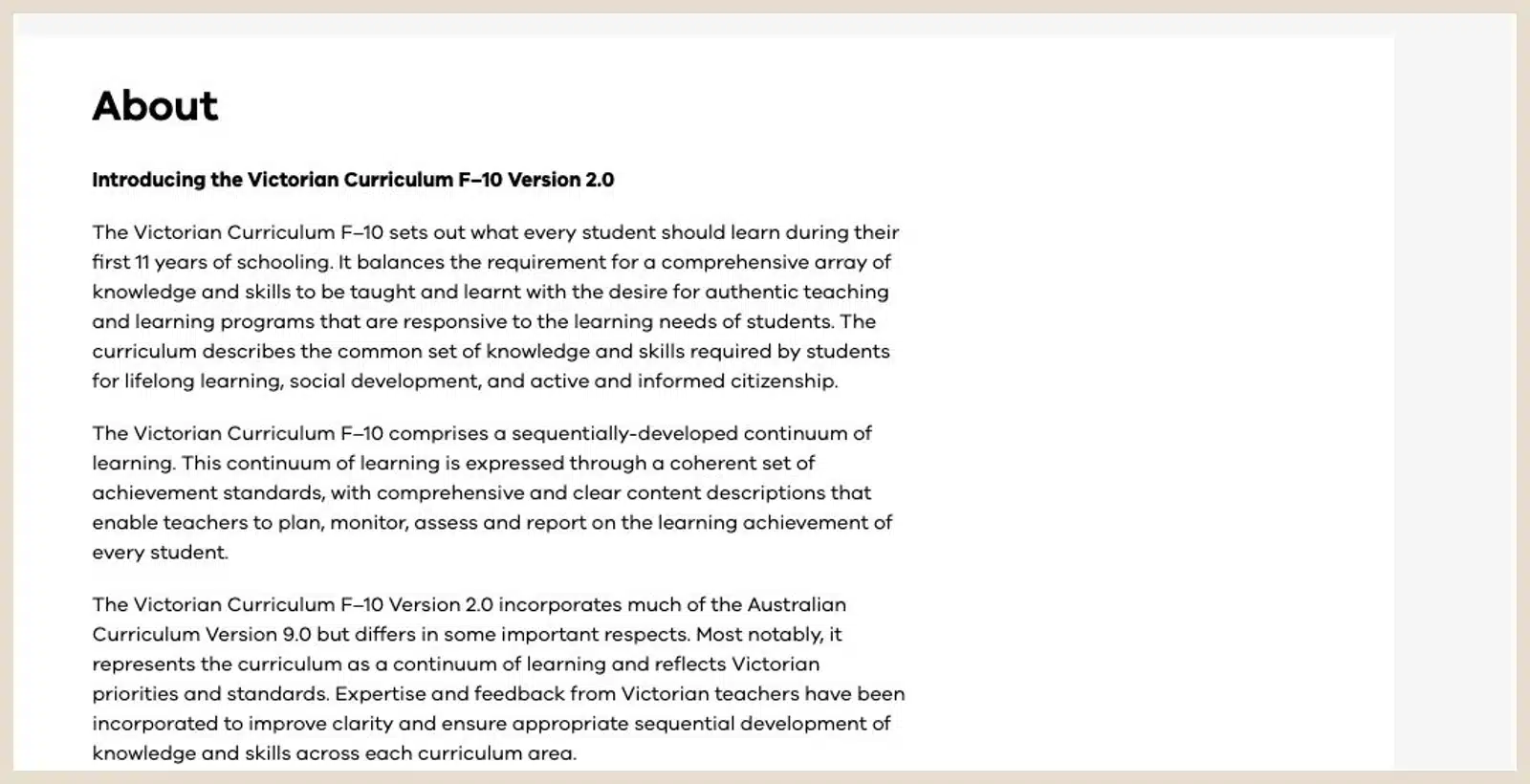
Victoria publishes the Victorian Curriculum F–10 Version 2.0. On its own “about” page, the VCAA describes Version 2.0 as incorporating much of Australian Curriculum Version 9 while differing in some respects — it has its own structure and reflects Victorian priorities.
Sector matters more in Victoria than most parents expect. Government and Catholic schools work to Version 2.0 according to their sectors’ arrangements, while independent schools may use the Victorian Curriculum as a model or resource for implementing the national curriculum — which means two Victorian schools can name different documents and both be in order.
Timing also varies by curriculum area: different areas of Version 2.0 sit on different implementation timelines, so check the VCAA implementation timeline for the areas that matter to your child. The schedule described here reflects the VCAA’s published position as of Term 2 2026 (last reviewed 21 July 2026).
Bottom line for Victorian parents: the Victorian Curriculum is connected to the national framework, not a separate invention. Use the VCAA pages, and ask your school which document and timeline it is working to.
The other six jurisdictions, briefly
Australian Capital Territory
The ACT Education Directorate’s current learning and teaching policy requires public schools to meaningfully incorporate the Australian Curriculum’s learning areas, general capabilities and cross-curriculum priorities, with the Directorate determining which version is implemented. The policy therefore is not a promise about a particular Version 9 date. It covers public schools; ACARA lists separate contacts for the ACT’s Catholic and independent sectors. Parents should also ask their school which version their child’s year level is using.
Northern Territory
The NT Government’s position is that NT schools deliver the Australian Curriculum, overseen by the NT Board of Studies. For Version 9, the official schedule phased learning areas in across two milestones: English, Mathematics and Health & Physical Education by 2025, with Technologies, Humanities and Social Sciences, Languages and the Arts following by 2026 (last reviewed 21 July 2026). Because that phasing is exactly the kind of detail a government can revise, treat the NT curriculum page as the source of truth and your child’s school as the guide to what’s happening in its classrooms this term.
Queensland
Queensland schools plan, teach, assess and report using the Australian Curriculum in Prep–Year 10, with QCAA providing current Version 9 support under its “Australian Curriculum in Queensland” (ACiQ) banner. Its material is organised learning area by learning area, so check the relevant QCAA Version 9 page and your school for the subject and year level that matter (last reviewed 21 July 2026).
South Australia
South Australia is the jurisdiction where the sector caveat matters most. Its public schools are progressively moving to the South Australian Curriculum for Public Education — a curriculum adapted from Australian Curriculum Version 9, developed and rolled out in phases. The 2024 official plan described phased development for Reception–Year 10 that was expected to be completed in 2027, and the department’s 2025 annual report records that Prototype 2 was delivered in 2025 with scaling work informing implementation activity in 2026 — evidence of progress, not a claim that the job is finished (last reviewed 21 July 2026). None of this automatically describes SA’s Catholic or independent schools, which make their own arrangements. SA parents outside the public system should ask their school or sector directly.
Tasmania
For Tasmanian government schools, a current procedure from the Department for Education, Children and Young People (DECYP, February 2025) identifies Australian Curriculum Version 9.0 as the core framework for Prep–Year 10. That is a clean, direct relationship with the national curriculum — but it is a government-school procedure, so parents with children in Catholic or independent schools should check with their school or its sector rather than assuming the same document applies.
Western Australia
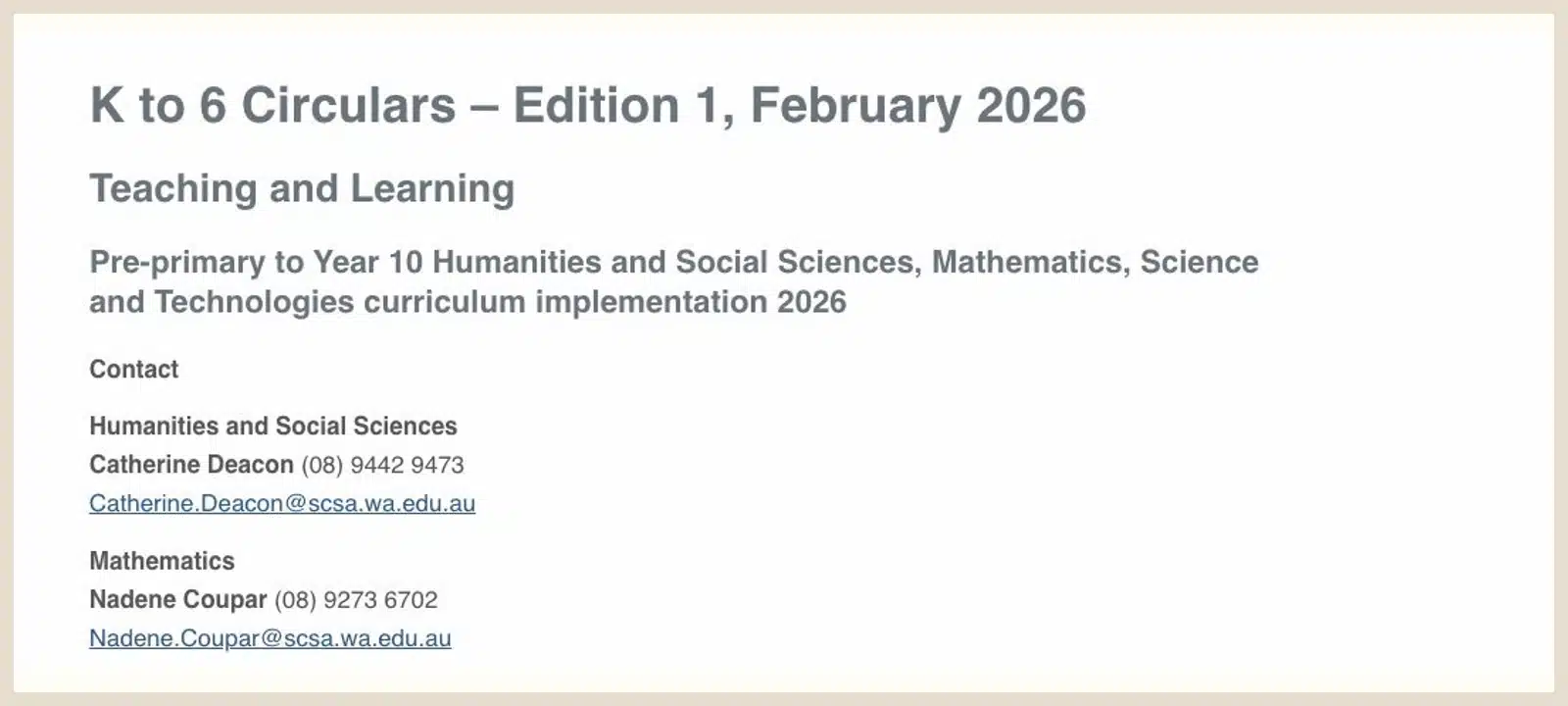
WA runs its own well-established structure: the School Curriculum and Standards Authority (SCSA) adopts and adapts Version 9 into the Western Australian Curriculum and Assessment Outline, which is why WA pages and codes can look different from ACARA’s even where the underlying content is aligned. On timing, SCSA’s February 2026 circular makes the revised HASS, Mathematics, Science and Technologies curriculum mandatory in 2026 (last reviewed 21 July 2026). That mandate is specific to those four learning areas — other areas may sit on different schedules, so check the K–10 Outline and current circulars for anything else.
Which curriculum website should you actually use?
Here is the five-step path we recommend to any Australian parent, in any jurisdiction:
- Identify your child’s jurisdiction and school sector. State or territory first; then government, Catholic or independent.
- Open that authority’s current curriculum or syllabus page — the live page, not an old downloadable timeline or a third-party summary.
- Select your child’s year level (or stage) and the learning area you’re interested in.
- Check the implementation note — the “new syllabus from…” or “mandatory in…” line that tells you which version applies right now.
- Ask the school if the page and your child’s classroom materials seem to disagree. Schools decide the program, sequence and timing, so they hold the final piece of the answer.
And here is a question you can use word for word:
“Which curriculum or syllabus version is this year level currently working from, and where can I see the relevant achievement standard or outcomes?”
It’s specific enough that any school can answer it, and the answer tells you exactly which documents to read.

What if your child moves interstate?
The shared national framework helps: a move between states is not an educational fresh start, but it is not a photocopy either. Your child may meet different terminology, content codes, teaching sequences and assessment timing.
Two practical moves smooth the transition. First, bring recent school reports and, if you can get it, a note of the units or topics covered this year — the receiving school can map prior learning much faster with those in hand. Second, ask the new school directly how it maps prior learning for interstate arrivals. What no one can honestly promise is a seamless, item-for-item content match; what you can reasonably expect is broad continuity with some local adjustment.
Does any of this apply to Years 11 and 12?
This Version 9 guide is about Foundation to Year 10. In Years 11 and 12, students follow jurisdiction-specific senior secondary courses, assessment arrangements and certificates. If that is the stage you are planning for, start with our guide to choosing Year 11 and 12 subjects.
Frequently asked questions
Does every Australian school teach the same curriculum?
No. Every jurisdiction works from the Australian Curriculum as the national framework, but states, territories, sectors and schools determine how and when it is implemented. Schools develop their own programs, so two schools can teach topics in a different order with different resources.
Does NSW use Australian Curriculum v9?
Yes. NESA incorporates Australian Curriculum content into NSW K–10 syllabuses through its “adopt and adapt” approach, and new NSW syllabuses are aligned with Version 9. NSW parents follow the applicable NESA syllabus rather than the national website.
Does Victoria use Australian Curriculum v9?
Victoria works through the Victorian Curriculum F–10 Version 2.0, which the VCAA describes as incorporating much of Australian Curriculum Version 9 while differing in structure and Victorian priorities. Government and Catholic schools follow sector arrangements; independent schools may use it as a model or resource for implementing the national curriculum.
Which states use the Australian Curriculum “directly”?
There’s no neat, permanent list — and be wary of any page that offers one. Whether a school works directly from ACARA’s published curriculum or through a jurisdiction document that incorporates it can differ by state, by sector and even by learning area. The eight-row table above shows what each jurisdiction’s authority currently says, which is the reliable version of the answer.
What curriculum does a Catholic or independent school use?
It depends on the jurisdiction and the sector, because government, Catholic and independent arrangements can differ within the same state or territory. ACARA’s implementation page lists sector contacts, and the school itself can tell you which curriculum or syllabus it follows — it’s a completely normal question to ask.
Why do curriculum codes look different between states?
Several jurisdictions incorporate or adapt the national framework into documents with their own structure, labels and codes. Different codes alone do not show that one state’s standards are higher or lower than another’s.
Will my child repeat or miss work when moving interstate?
Possibly some of both, in small ways — sequencing and timing differ between jurisdictions, so an interstate move can mean meeting a topic twice or arriving after one has passed. The shared national framework keeps the broad picture continuous, and schools handle this routinely: share recent reports and covered topics with the new school and ask how it maps prior learning.
Does Australian Curriculum v9 apply to Years 11 and 12?
No — the Version 9 curriculum covered here is Foundation–Year 10. ACARA’s current senior secondary links remain Version 8.4, while students follow jurisdiction-specific courses, assessment and certificates. See our subject-selection guide when you reach that stage.
When did Version 9 actually start?
Education ministers approved Version 9.0 in April 2022 — but approval is not a classroom start date. Implementation timing has been determined jurisdiction by jurisdiction, sector by sector and learning area by learning area, which is why this article exists.
A calm next step
You don’t need to master eight education systems — just your own corner of one. Identify your jurisdiction and sector, open the authority page from the table above, and ask your school the question in this guide. Between those three layers, you’ll have the accurate answer for your child, which is worth more than any national generalisation.
For the framework itself, keep our Australian Curriculum v9 parent guide bookmarked. You can also read The three dimensions of Australian Curriculum v9, Content descriptions, elaborations and achievement standards and our Year 7 Australian Curriculum guide.
This article was last reviewed on 21 July 2026 against current official sources. Implementation details change; always confirm time-sensitive information on the linked authority pages.