

Content Descriptions, Elaborations and Achievement Standards: What’s the Difference?
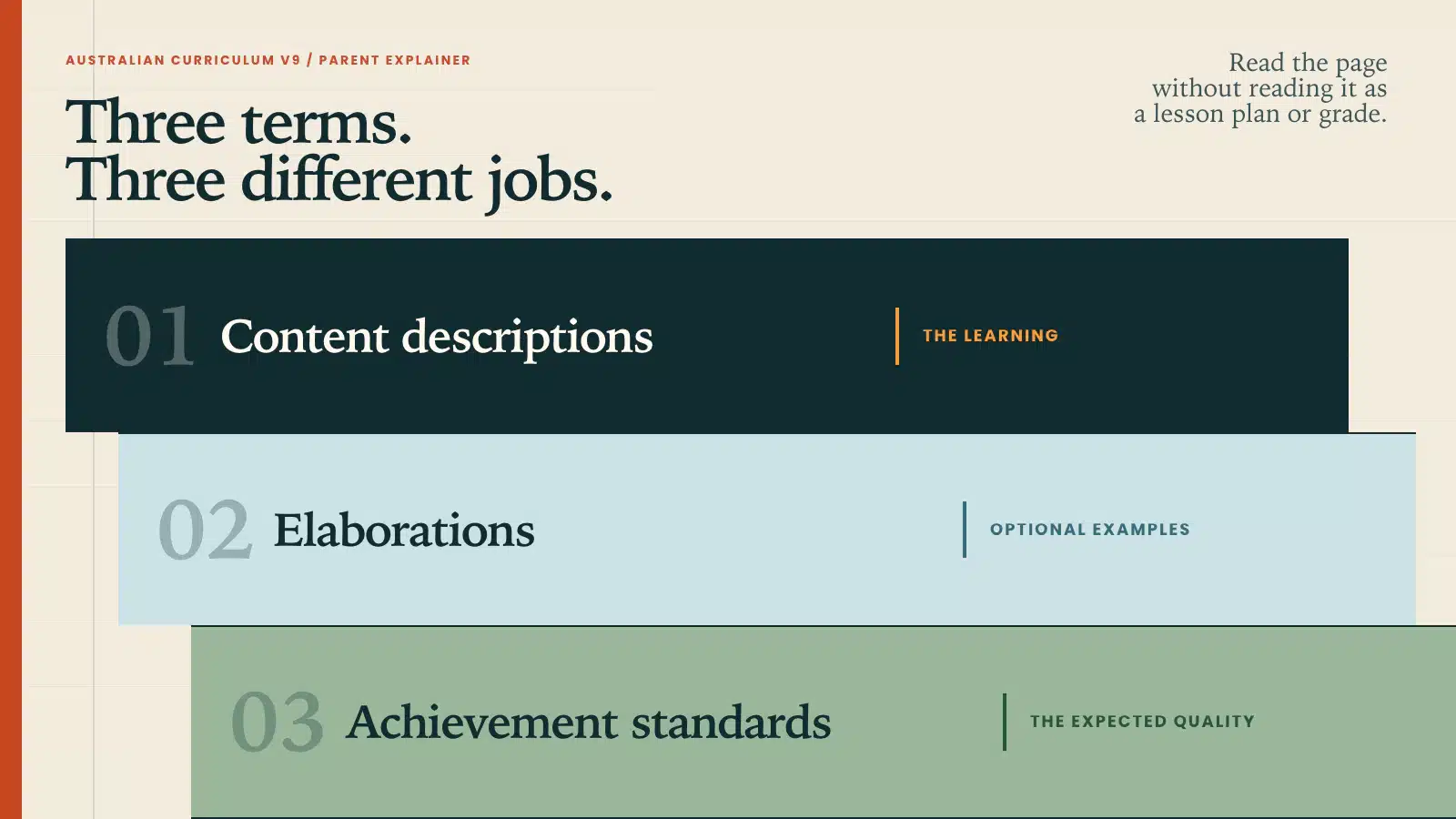
If you have opened a page of the Australian Curriculum and found the terminology hard to follow, here is the short answer. Content descriptions identify the essential knowledge, understanding and skills students are expected to learn. Elaborations are optional examples of ways that learning may be explored. Achievement standards describe the expected quality of learning students typically demonstrate by the end of a year or a two-year band.
Just as important is what these terms are not. A content description is not a lesson plan. Elaborations are not an extra set of subjects your child must cover. An achievement standard is not a universal grading formula. All three are parts of the Foundation to Year 10 Australian Curriculum Version 9.0, and each answers a different question about your child’s learning.
This explainer sits within our complete parent guide to Australian Curriculum Version 9. Below, we unpack each term, walk through a real Year 7 English page, and finish with a five-step method for reading any curriculum page.
The 60-second version
| Term | Parent translation | Is it required? | What it is not |
|---|---|---|---|
| Content description | What students are expected to learn | The described learning is part of curriculum content | A fixed lesson or worksheet |
| Elaboration | One possible example of how to explore it | No — optional | Extra compulsory content |
| Achievement standard | Expected quality of learning by the end of a year or band | Used to describe and judge expected learning | A universal grade formula |
Each term answers its own question. A content description answers: what are students expected to learn? An elaboration answers: what could that learning look like in practice? An achievement standard answers: what quality of learning is expected by the end of the year or band?
One boundary is worth setting early. These three terms are curriculum content elements that sit inside each learning area. They are not the same thing as the three dimensions of Australian Curriculum Version 9 — the eight learning areas, the general capabilities and the cross-curriculum priorities. If you have read about the curriculum’s “three-dimensional” design, keep that idea separate from the three terms in this article.
How the three parts fit together
The relationship is simpler than the terminology suggests, as long as you resist one tempting assumption.
Content descriptions identify the learning for a year or band, organised under headings called strands. Elaborations sit underneath individual content descriptions and illustrate possibilities — one way a teacher might bring that content to life. The achievement standard then describes the expected quality of learning across the whole body of that year or band’s content.
The word across matters. The achievement standard is written as a connected description of learning, not as a checklist matched line-by-line to the content descriptions. One content description does not equal one sentence of the achievement standard, and you will not find a tidy one-to-one map between them. Reading a curriculum page becomes much easier once you stop looking for that map: the content descriptions tell you what is taught and learned, and the achievement standard tells you what the learning typically looks like when it comes together by the end of the year.
Content descriptions: the essential learning
The Australian Curriculum, Assessment and Reporting Authority (ACARA), which developed the Australian Curriculum and continues to refine it, defines content descriptions as the essential knowledge, understanding and skills that students are expected to learn, and teachers are expected to teach, in each year or two-year band.
On a curriculum page, content descriptions are organised through strands, and in many learning areas sub-strands, which act like section headings. In Year 7 English, for example, the Language strand gathers content about how the English language works. Each content description also carries a code, such as `AC9E7LA01`. On the live page, that code identifies one specific content description. It is not a mark or grade, and parents never need to memorise codes to understand a page.
Two cautions will save you misreadings. First, content descriptions are not all the same size. ACARA states that content descriptions are not all of “equal size”, and teachers are not expected to allocate equal time to each. Some content threads through an entire year of teaching; other content is addressed in a shorter span. So counting content descriptions tells you nothing reliable about how many lessons or weeks anything takes.
Second, a content description is not a ready-made lesson, worksheet or assessment task. It describes learning, not delivery.
Parents often ask: does my child have to learn every content description? The described learning is part of the curriculum content for the year or band — it is the “what” of the curriculum. But decisions about when it is taught, in what order, through which activities and alongside which resources are made by state and territory authorities, school sectors, schools and teachers, not by the national document. The curriculum sets the learning; your school shapes the program.
Elaborations: optional examples, not extra requirements
Elaborations are the most commonly misread element, and the correction is reassuring: they are optional.
ACARA describes content elaborations as suggestions and illustrations of ways to teach the content descriptions. They are optional material only — not a complete or comprehensive list of things every student must be taught. The live curriculum website says this directly on the page where elaborations appear: content elaborations provide suggestions of ways to teach the content description, and content elaborations are optional.

Think of an elaboration as one worked possibility. A teacher might use an elaboration exactly as written, adapt it, or choose a different example or activity that suits their class, school context or available resources. That is why two schools can address the same content description through entirely different activities — one class might explore a concept through local examples, another through a novel study or a media project — and both are teaching the same curriculum content.
So if you are scanning a curriculum page and the elaborations mention an activity your child has never done, nothing is missing. The content description is the expectation; the elaborations simply make it concrete. They are not a checklist, and no school is required to teach every elaboration — or any particular one.
Achievement standards: expected quality, not a grade
Achievement standards carry the most weight for parents, because they sound like they should tell you how your child is doing. They are useful for that conversation — but they are not a grade, and reading them as one is the most common misstep parents make.
ACARA defines achievement standards as describing the expected quality of learning that students should typically demonstrate by the end of each year or two-year band. Notice what that sentence does and does not say. It describes expected quality — the depth and sophistication of learning typically demonstrated — at a defined point in time. It does not assign a mark, a letter or a ranking.
Teachers use achievement standards to monitor learning across the year and to make what are called on-balance judgements: professional judgements that weigh evidence from many tasks and observations, rather than scoring a single test against the standard. ACARA also publishes annotated work samples that illustrate what achievement in relation to a standard can look like. Work samples are supporting illustrations for teachers — not a universal marking key, and not a guarantee about any individual student.
Here is the boundary that matters most: how achievement is reported to you — the labels, the scale, the format of the report card — is determined by state and territory authorities, school systems and schools, not by the national curriculum. The same national achievement standard sits behind different local reporting conventions.
Queensland offers a clearly labelled local example. The Queensland Curriculum and Assessment Authority describes a relationship between the achievement standard and the “C standard” used in Queensland reporting. That is a Queensland decision about how achievement is reported. It is not a national rule, and other states and sectors express their reporting in their own ways.
So when you read an achievement standard, read it as a description of expected quality — a reference point for a conversation with your school — not as a sentence that equals your child’s grade.
Worked page-reading example: Year 7 English
This section is a worked page-reading example. It shows how to read a live curriculum page — it is not a lesson suggestion or an assessment recommendation.

Open the Year 7 English page on the Australian Curriculum website and you will see the Year 7 achievement standard presented for the year, beginning “By the end of Year 7, students interact with others…”. That is the broad description of expected quality across the year’s learning.
Below it sit the content descriptions, organised by strand. Under the Language strand, in the sub-strand about language for interacting with others, the first content description carries the code `AC9E7LA01`: “understand how language expresses and creates personal and social identities”.
Selecting that content description reveals its two elaborations. One suggests understanding local idioms and discussing how they connect with personal and social identities. The other suggests developing dialogue that reveals character in comics, cartoons and animations. The page states plainly that content elaborations are optional.
From this one page, here is what you can safely conclude: the content description identifies specific learning about language and identity; the two elaborations illustrate possible ways into that learning; and the achievement standard describes the expected quality of learning across Year 7 English as a whole.
And here is what you cannot conclude: that both elaborations must be taught (they are optional examples); that `AC9E7LA01` maps to the whole Year 7 achievement standard (it is one content description among many, and the standard describes learning across all of them); or that this page reveals your child’s grade (reporting is a local decision built on school-based evidence).
How to read any curriculum page in five steps

- Check the learning area and the year or band. Make sure you are looking at the right subject and the right year level — some subjects present curriculum in two-year bands.
- Read the achievement standard first. It gives you the broad end point: the expected quality of learning by the end of the year or band. Read it as a whole description, not a checklist.
- Scan the strands and sub-strands. These headings show you how the learning area is organised, and where to find the content that interests you.
- Read the content descriptions and note their codes. These are the essential learning. The code identifies the exact content item if you ever want to ask a teacher about it.
- Treat elaborations as optional examples — then ask the school about the actual program. The page tells you what is to be learned; your school can tell you how it is being taught and assessed this term.
Five minutes with this method turns a dense official page into something you can navigate confidently.
Why your school may use different words or examples
The Australian Curriculum is a national framework. States, territories and non-government school authorities are responsible for delivering it in their schools, and each brings its own syllabus documents, terminology, planning and reporting arrangements. Our state and territory guide maps how that plays out where you live.
This is why the national curriculum does not determine your child’s textbooks, the order of lessons, homework, the assessment calendar or the format of the school report. Those decisions sit with your state or territory, your school’s sector, the school itself and the classroom teacher. If your school’s program notes use different wording from the national page, that is normal — the national content sits behind local planning.
One piece of history helps too: Version 9.0 strengthened the alignment between curriculum content elements. Our Version 9 changes guide covers what changed.
Common myths, corrected
| Myth | Correction |
|---|---|
| “Every elaboration must be taught.” | No. Elaborations are optional examples; teachers may use different examples. |
| “One content description equals one lesson.” | No. Content descriptions differ in size and are not units of teaching time. |
| “The achievement standard is my child’s grade.” | No. It describes expected quality of learning; reporting formats and grade conventions are set locally. |
| “Every state reports against it in exactly the same way.” | No. Jurisdictions, sectors and schools determine reporting styles and formats. |
| “These are the curriculum’s three dimensions.” | No. They are content elements within learning areas; the three dimensions are a separate design idea. |
Questions parents can ask the teacher
If you want to connect a curriculum page to your child’s actual classroom, three calm questions do the work:
- Which content descriptions is the class working on at the moment?
- What would progress toward the relevant achievement standard look like in this task or unit?
- Are the examples I can see on the curriculum page the ones the class is using, or are they optional elaborations?
These questions respect the teacher’s professional judgement while giving you a clear picture of what is being taught and what evidence informs judgements about progress.
FAQ
Are Australian Curriculum elaborations mandatory?
No. ACARA describes elaborations as optional suggestions and illustrations of ways to teach the content descriptions. They are not a complete list of required content, and teachers may use different examples entirely.
Are achievement standards the same as grades?
No. An achievement standard describes the expected quality of learning by the end of a year or two-year band. Grades, marks and report formats are reporting conventions determined by states, territories, systems and schools. Queensland’s “C standard” convention, for instance, is a Queensland decision, not a national one.
What is a content descriptor in the Australian Curriculum?
Many people search for “content descriptors”, and the meaning is the same — ACARA’s current term is content descriptions: the essential knowledge, understanding and skills students are expected to learn in each year or band.
Does every content description need the same amount of teaching time?
No. ACARA is explicit that content descriptions are not all of equal size, and teachers are not expected to give each one equal time.
Why can two schools use different activities for the same content?
Because the curriculum describes learning, not delivery. Teachers choose activities, texts and contexts — including whether to use the optional elaborations — to suit their students and school.
What does a code such as AC9E7LA01 mean?
On the live page, it identifies one specific content description — in this case, a Year 7 English content description in the Language strand. It is not a mark or grade, and parents don’t need to decode it.
Are achievement standards set for every year level?
Achievement standards may be presented for a single year or a two-year band, depending on the learning area or subject.
Where can parents see official content descriptions and elaborations?
On the official Australian Curriculum Version 9 website, australiancurriculum.edu.au. Open a learning area, choose the year level, and select any content description to see its optional elaborations.
The short version, and where to next
Content descriptions identify the essential learning, elaborations are optional examples, and achievement standards describe the expected quality of learning by the end of a year or band. The most useful next step is to open your child’s year-level page on the official site, read it with the five steps above, and talk with your school about how the actual class program brings it to life. For the bigger picture, start with our complete parent guide to Australian Curriculum Version 9.
Official sources:
- About the curriculum content elements — ACARA
- Planning, teaching, assessing and reporting — ACARA
- Parent information glossary — ACARA
- English Year 7 — Australian Curriculum Version 9
Last reviewed: 28 July 2026.