

Year 7 Curriculum in Australia: What Students Learn in Version 9
The 60-second answer
Australia has a national Year 7 framework — the Australian Curriculum, Version 9.0 — but it does not have one identical Year 7 program running in every school. Both of those things are true at once, and holding onto both is the key to making sense of everything else you’ll read about Year 7.
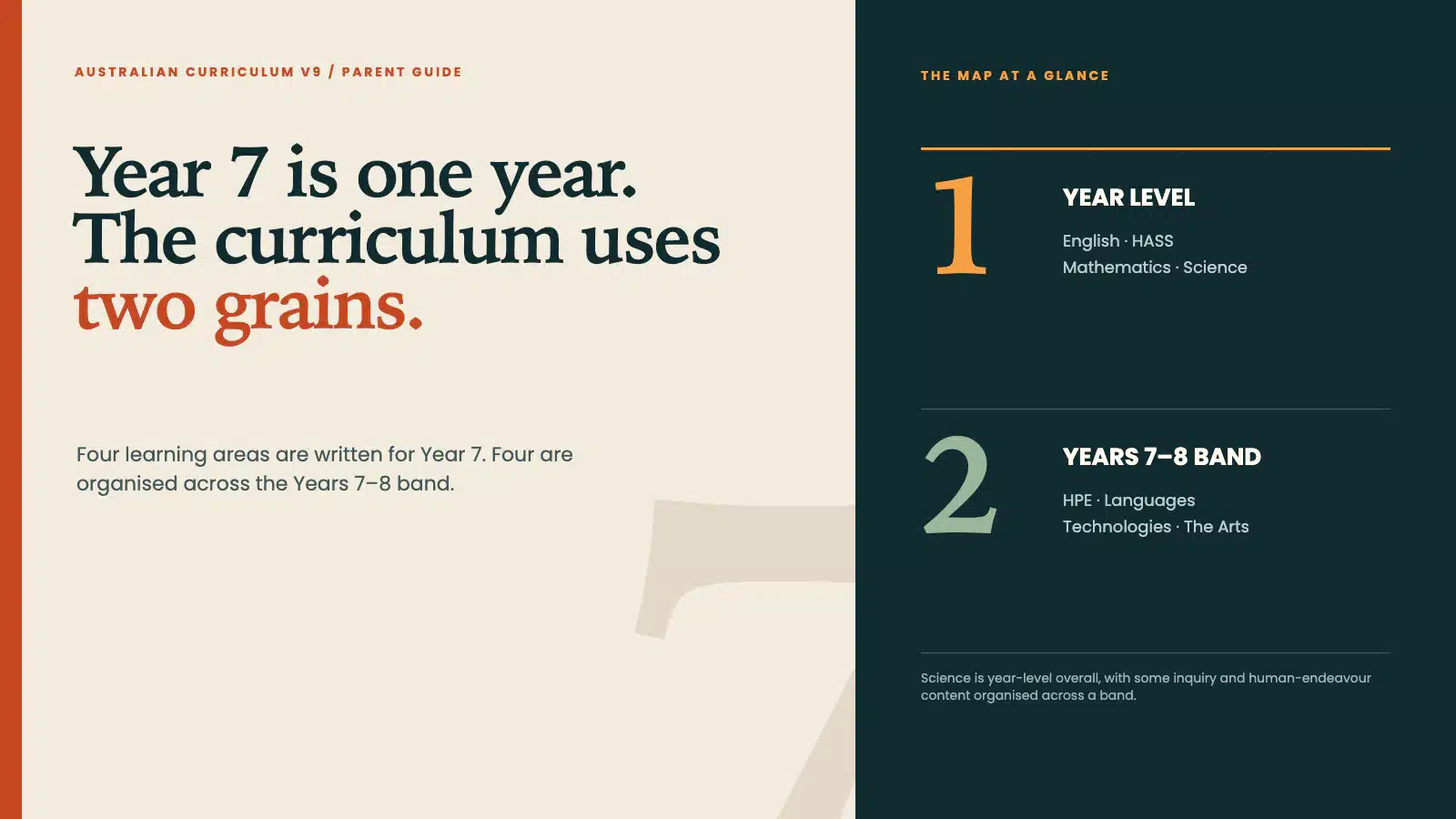
The national curriculum describes what students around the country are expected to learn from Foundation to Year 10. When it comes to Year 7, though, it doesn’t describe every learning area the same way:
| Specified at each year level | Organised across the Years 7–8 band |
|---|---|
| English, Humanities and Social Sciences (HASS), Mathematics, Science | Health and Physical Education (HPE), Languages, Technologies, The Arts |
For the learning areas in the left column, the curriculum sets out expectations for Year 7 specifically. For the learning areas in the right column, it describes what students learn across Years 7 and 8 together, and each school decides how that learning is spread over the two years.
One nuance worth knowing: Science sits in the left column, but some of its science inquiry and "science as a human endeavour" content descriptions are organised across a band of years rather than a single year. So even Science isn’t a strictly one-year checklist in every element.
Everything beyond that framework — which subjects appear on your child’s timetable, what they’re called, the order topics arrive in, how homework runs, when assessment happens and what reports look like — is shaped by your state or territory, your school’s sector and the school itself. This guide walks through what the national framework says about Year 7, and then shows you exactly where to look locally for the rest.
What "Year 7 curriculum" actually means
When people say "the Year 7 curriculum", they can mean three different layers, and it helps to keep them apart.
The first layer is the national framework. The Australian Curriculum, developed by ACARA and released as Version 9.0 in May 2022, sets out what students should learn from Foundation to Year 10. It’s built from eight learning areas, seven general capabilities and three cross-curriculum priorities. If you’d like the full picture of how the framework works, our parent guide to Australian Curriculum Version 9 covers it, and our guide to what changed in Version 9 explains how it differs from the previous version.
The second layer is your state, territory or school sector. Education authorities — government and non-government — decide how the national framework is delivered in their schools. Some adopt it directly; others deliver it through their own syllabus or curriculum documents. The word "syllabus" on a school’s website usually points to this layer.
The third layer is the school and classroom. Within the rules of its jurisdiction and sector, a school builds its actual Year 7 program: which subjects run, what they’re named, how classes are grouped, and how the year unfolds week by week.
One more distinction saves a lot of confusion: a learning area is not the same thing as a timetable subject. There are eight learning areas, but English, Mathematics, Science and HPE each comprise a single subject, while HASS, The Arts, Technologies and Languages contain multiple subjects or language options. So "eight learning areas" does not mean your child will have eight subjects — a Year 7 timetable may show more, fewer, or differently named subjects than the national list.
Why Year 7 can feel different
Year 7 commonly marks the start of secondary school in Australia, and ACARA’s own parent overview notes that it generally brings subject-specialist teachers and new organisational and personal demands. Many students move from a primary classroom model to subject-specialist teachers for most learning areas, navigate a rotating timetable, and carry more responsibility for being in the right place with the right books.

Australian transition research and state education departments describe the same picture from the family’s side: a new environment, a new peer group, a bigger workload, different behavioural expectations and a step up in self-management. None of this makes Year 7 a crisis year — for many students it’s an exciting fresh start — but it explains why a child who cruised through Year 6 may need time to find their rhythm.
Schools know this, and they can tailor transition and learning support to individual students. If your child needs more support — or more challenge — the school is the right first conversation, and question five at the end of this guide is written for exactly that.
What students learn across the eight learning areas
Here is the national map of Year 7 learning, area by area. Two labels matter as you read: "Year 7" means the curriculum specifies expectations for this year level; "Years 7–8 band" means the curriculum describes two years of learning that schools sequence themselves. The plain-language summaries below draw on ACARA’s parent overview of Years 7–8 learning — so treat them as a two-year horizon, not a Year 7 term planner. They are an orientation, not the full curriculum; the official learning areas pages hold the complete detail.

English — Year 7 curriculum
Across Years 7–8, ACARA’s parent summary describes students interpreting and evaluating increasingly demanding texts, supporting their ideas with evidence, building arguments, and creating their own written and multimodal texts. Vocabulary keeps growing, and spoken interaction — discussing, presenting, responding — remains part of the subject. Because English has a year-level curriculum, Year 7 has its own content descriptions and achievement standard; we walk through the actual Year 7 English page later in this guide.
Mathematics — Year 7 curriculum
Year 7 Mathematics includes working with positive and negative numbers, the move into algebra, rates and ratios, graphs, financial contexts, measurement, Pythagoras’ theorem, and chance and statistics. For many students the shift from arithmetic answers to algebraic thinking is the biggest single change from primary maths. Treat this as an overview rather than an exhaustive checklist — the official Year 7 Mathematics curriculum sets out the precise expectations.
Science — Year 7 curriculum (with some banded elements)
The Years 7–8 overview spans biological sciences (ecosystems and cellular systems), Earth sciences, chemical sciences (particles and change) and physical sciences (energy and systems), alongside science inquiry skills and "science as a human endeavour" — how scientific knowledge interacts with ethics, culture and real decisions. Science has a year-level curriculum, but remember the earlier nuance: some inquiry and human-endeavour content descriptions are banded, so schools have room in how they sequence those elements.
Humanities and Social Sciences — Year 7 curriculum
In Years 7–10, HASS is represented through four subjects: History, Geography, Civics and Citizenship, and Economics and Business. In Year 7 History, the curriculum names two sub-strands: Deep time history of Australia and The ancient world. How the four subjects appear on a timetable varies: some schools run an integrated "Humanities" line, others timetable the subjects separately or by semester.
Health and Physical Education — Years 7–8 band
The Years 7–8 HPE curriculum takes in identity, respectful relationships, health and wellbeing, movement and physical activity, and leadership and collaboration. Because this is a banded learning area, the curriculum describes what students learn across Years 7 and 8 together — which topics land in which year is the school’s call.
The Arts — Years 7–8 band
The Arts learning area contains five subjects: Dance, Drama, Media Arts, Music and Visual Arts, organised across the Years 7–8 band. Schools organise their Arts offerings in very different ways — rotations through several art forms, semester units, or chosen electives — so two schools can both be delivering The Arts through quite different Year 7 timetables.
Technologies — Years 7–8 band
Technologies contains two subjects — Design and Technologies, and Digital Technologies — organised across Years 7–8. Design and Technologies covers designing and producing solutions to real problems; Digital Technologies covers computational thinking, programming, data, and staying safe and private online. A distinction worth keeping: Digital Technologies is a subject, while digital literacy — using digital tools confidently across all subjects — is a general capability that runs through everything. They’re related, not the same thing.
Languages — Years 7–8 band
In Year 7 your child may continue a language they began in primary school or start a new one. The Languages curriculum is organised across the Years 7–8 band, and — importantly — which languages a school offers, and whether your child enters as a beginner or continues an existing pathway, are local decisions. If a particular language matters to your family, it belongs on your list of questions for the school.
The other two dimensions: capabilities and priorities
Alongside the eight learning areas, the curriculum has two further dimensions, and it’s worth knowing what they are — mostly so you don’t mistake them for extra subjects.
The seven general capabilities — Critical and Creative Thinking, Digital Literacy, Ethical Understanding, Intercultural Understanding, Literacy, Numeracy and Personal and Social capability — are developed through the learning areas, not taught as seven additional classes. When a Year 7 student weighs evidence in History or interprets data in Science, capabilities are being built inside subject learning.
The three cross-curriculum priorities — Aboriginal and Torres Strait Islander Histories and Cultures; Asia and Australia’s Engagement with Asia; and Sustainability — are incorporated through learning-area content where most appropriate and authentic, rather than operating as standalone subjects. They won’t appear identically in every lesson, and they won’t show up as lines on a timetable.
If you’d like the fuller story of how the three dimensions fit together, our guide to the three dimensions of the Australian Curriculum covers it in parent language.
What can differ by state, school and classroom

Because states, territories and non-government authorities determine how the curriculum is delivered, and schools make further program decisions on top of that, plenty of things that feel like "the curriculum" are actually local choices. Expect legitimate variation in:
- Sequencing — especially in banded learning areas, where schools decide which Years 7–8 content sits in Year 7 and which waits for Year 8, and in Science’s banded inquiry elements.
- Subjects and courses — how learning areas are combined, split, named and offered, including electives and language options.
- Timetables — how many periods, which subjects each semester, and how classes are grouped.
- Homework — the national curriculum sets no homework policy; schools do.
- Assessment schedules — when tests and assignments fall is a school decision, not a national calendar.
- Reporting — how progress is reported, including whether and how A–E grades are used, is set by jurisdictions and schools rather than by the national framework.
None of this variation means a school is "off-curriculum". It’s the system working as designed: a national framework, delivered locally. For how delivery is organised where you live, see our state-by-state guide to the Australian Curriculum.
What "working at Year 7 level" does — and doesn’t — mean
Each year level or band in the curriculum ends with an achievement standard: a description of the expected quality of learning that students should typically demonstrate by that point. When a teacher talks about a child "working at Year 7 level", this is usually the reference point behind the phrase.
Two things follow from that. First, an achievement standard is a description of expected learning — it is not a national grading formula. Teachers use professional judgement about student evidence against the standard, and how that judgement is turned into your child’s report — including any A–E scale — is a jurisdiction and school matter. Two honest report cards in two states can look quite different while describing similar learning.
Second, NAPLAN is not a whole-curriculum result. Year 7 students sit NAPLAN, and it provides useful information — but it assesses aspects of literacy and numeracy, not the eight learning areas. A NAPLAN report can’t tell you how your child is going in Science, History or Drama, and it isn’t a verdict on their Year 7 as a whole. The school’s reporting against achievement standards is the broader picture.
If terms like content descriptions, elaborations and achievement standards are new to you, our plain-English guide to curriculum terms unpacks each one.
A worked example: reading an official Year 7 page
The fastest way to feel at home with the curriculum is to read one official page with a guide alongside. Open the Year 7 English curriculum on the Australian Curriculum website and you’ll see the same anatomy every learning area uses.

Four features to notice:
- The year selector. The English page is filtered to Year 7 because English is published at each year level. Banded learning areas are published for Years 7–8.
- Content descriptions. These are the individual statements of what teachers are expected to teach — the "what" of the curriculum.
- Elaborations. Under content descriptions sit elaborations: optional suggestions and illustrations of ways teachers might teach a content description. They are not mandatory, and your child’s class is not required to do the specific activities they mention.
- The achievement standard. The description of expected learning by the end of Year 7 — the reference point for "working at year level" discussed above.
You don’t need to read curriculum pages the way a teacher planning a term does. But knowing which parts are requirements and which are illustrations makes every conversation with the school easier.
Five questions worth asking your school
The national framework tells you what Year 7 broadly holds; your school holds the rest. These five questions surface it quickly.
- Which state or territory curriculum or syllabus applies here? This tells you which documents actually govern your child’s classroom, and where to read more.
- Which subjects will my child actually see on the timetable? Names, combinations and electives are school decisions — get the real list rather than assuming it matches the national learning areas.
- How does the school sequence Years 7–8 banded content? For HPE, Languages, Technologies and The Arts, this is how you find out what actually happens in Year 7 versus Year 8.
- How will progress and achievement be reported? Ask what the reports look like, how often they come, and how the school describes "at year level".
- What should we know about transition, extension or support? Ask early so you can understand what transition, extension or support arrangements are available.
Frequently asked questions
Is Year 7 the same across Australia?
The framework is national, so the broad expectations are shared. But delivery is decided by states, territories and sectors, and the actual program — subjects, sequence, timetable, assessment — is shaped by each school. Two Year 7 students in different schools are working toward the same framework through legitimately different programs.
Does Year 7 have eight subjects?
Not necessarily — the curriculum has eight learning areas, which is a different thing. Some learning areas are one subject (English, Mathematics, Science, HPE); others contain several (HASS has four, The Arts five, Technologies two, and Languages varies). The school’s timetable determines what your child experiences as "subjects".
What’s the difference between a curriculum and a syllabus?
In everyday conversation they blur together. In Australia, the Australian Curriculum is the national framework, while some state and territory authorities publish syllabuses or their own curriculum documents that deliver it locally. Which applies to your child depends on where you live and the school’s sector.
Is everything in a Years 7–8 summary taught in Year 7?
No. Content organised in the Years 7–8 band is addressed across the two years, and schools decide the split and the order. A Years 7–8 overview is a two-year horizon, not a Year 7 checklist.
What subjects are compulsory in Year 7?
The Australian Curriculum sets out the learning areas for Foundation–Year 10, but decisions about which subjects a Year 7 student must take — and where choice or electives begin — sit with jurisdictions, sectors and schools. Ask your school for its Year 7 subject structure rather than relying on a national list.
Does NAPLAN show whether my child is "at Year 7 level"?
NAPLAN assesses aspects of literacy and numeracy, and it’s useful for exactly that. It doesn’t assess the whole Year 7 curriculum, so it can’t stand in for school reporting against achievement standards across the learning areas.
Is Digital Technologies the same as digital literacy?
No. Digital Technologies is a subject within the Technologies learning area — computational thinking, programming, data, digital systems. Digital literacy is a general capability developed across all subjects. A school could timetable Digital Technologies in Year 8, while still building digital literacy throughout Year 7.
What happens if my child changes states during high school?
The national framework provides a common national reference point. But subject names, sequencing — especially of banded content — assessment and reporting can all differ. Our state-by-state guide is the place to start, alongside a conversation with the new school.
Where can I see the official curriculum content?
Use ACARA’s parent information and the official learning-area pages. Both are free and public, and the worked example above shows you how to read a page.
What should I read next?
If the framework itself is new to you, start with our parent guide to Version 9. If you’re trying to understand your local arrangements, the state-by-state guide is the next stop.
Where to next
This overview is the national map. From here, the most useful next steps depend on your question:
- Australian Curriculum Version 9: a parent guide — the whole framework in plain language.
- What changed in Version 9 — if you knew the previous version.
- The three dimensions of the Australian Curriculum — learning areas, capabilities and priorities.
- The Australian Curriculum by state and territory — who delivers what, where you live.
- Content descriptions, elaborations and achievement standards — the curriculum’s language, decoded.
For subject-specific detail, read the Year 7 English guide and Year 7 Mathematics guide.
Whether Year 7 is approaching or already underway, KeirEd offers one-on-one tutoring in every subject, and small-group programs for Queensland students. You can contact KeirEd to discuss your child’s learning, the relevant program and the practical commitment.
Last reviewed: 31 July 2026.